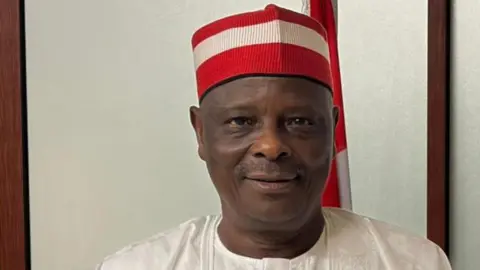
The coalition poised to challenge Nigeria's president in next year's election has received a major boost after prominent opposition figure Rabiu Musa Kwankwaso announced that he was joining. Kwankwaso, a former governor of Kano state, said on Monday he was now part of the African Democratic Congress (ADC), a day after resigning from the New Nigeria People's Party (NNPP).
A number of opposition heavyweights have joined the emerging ADC coalition in an effort to unseat President Bola Tinubu's All Progressives Congress (APC), which has been in power since 2015. Former Vice-President Atiku Abubakar and ex-state governor Peter Obi, two of Tinubu's biggest rivals, have become the face of the ADC. Kwankwaso ran for president in 2023, finishing fourth, while Abubakar and Obi came second and third respectively.
However, with many big names joining the ADC, the major question heading into the election season is who will be its presidential candidate, an issue that could potentially lead to splits. On Sunday, Kwankwaso announced he was stepping down as NNPP's leader, stating that the current trajectory of the nation's political landscape calls for strategic realignment.
I have found it necessary to identify with another political platform that offers the best opportunity to effectively change the nation, he emphasized in a statement. On social media, he confirmed his movement to the ADC, heralding a New dawn. We are ADC.
Accompanying video footage showed hundreds of people celebrating at a political rally, wearing red caps synonymous with Kwankwaso's well-known Kwankwasiyya movement.
With less than a year until the next general election, the ruling APC has endorsed President Tinubu for a second term in the January 2027 poll, where his victory is widely anticipated. Kwankwaso's sizeable support base, particularly among northern Nigeria's predominantly Muslim voters, offers an appealing prospect for the ADC amidst rising security challenges.
Despite speculation about his allegiance to the ADC, his transition was met with enthusiasm from his supporters, who were seen gathering outside his home to show their support. Kwankwaso's political journey has been marked by previous party switches, yet his followers have remained loyal through these changes. As the ADC aligns itself for the upcoming elections, Kwankwaso's history as a former defense minister may serve as a significant advantage in their rallying efforts.
The ADC's strengthening amid internal crises within Nigeria's primary opposition parties, the People's Democratic Party (PDP) and Labour Party (LP), marks a pivotal moment ahead of the 2027 elections. With electoral reforms aimed at enhancing transparency in the voting process, the ADC's strategic move bolsters its potential to significantly impact the political landscape of Nigeria.
A number of opposition heavyweights have joined the emerging ADC coalition in an effort to unseat President Bola Tinubu's All Progressives Congress (APC), which has been in power since 2015. Former Vice-President Atiku Abubakar and ex-state governor Peter Obi, two of Tinubu's biggest rivals, have become the face of the ADC. Kwankwaso ran for president in 2023, finishing fourth, while Abubakar and Obi came second and third respectively.
However, with many big names joining the ADC, the major question heading into the election season is who will be its presidential candidate, an issue that could potentially lead to splits. On Sunday, Kwankwaso announced he was stepping down as NNPP's leader, stating that the current trajectory of the nation's political landscape calls for strategic realignment.
I have found it necessary to identify with another political platform that offers the best opportunity to effectively change the nation, he emphasized in a statement. On social media, he confirmed his movement to the ADC, heralding a New dawn. We are ADC.
Accompanying video footage showed hundreds of people celebrating at a political rally, wearing red caps synonymous with Kwankwaso's well-known Kwankwasiyya movement.
With less than a year until the next general election, the ruling APC has endorsed President Tinubu for a second term in the January 2027 poll, where his victory is widely anticipated. Kwankwaso's sizeable support base, particularly among northern Nigeria's predominantly Muslim voters, offers an appealing prospect for the ADC amidst rising security challenges.
Despite speculation about his allegiance to the ADC, his transition was met with enthusiasm from his supporters, who were seen gathering outside his home to show their support. Kwankwaso's political journey has been marked by previous party switches, yet his followers have remained loyal through these changes. As the ADC aligns itself for the upcoming elections, Kwankwaso's history as a former defense minister may serve as a significant advantage in their rallying efforts.
The ADC's strengthening amid internal crises within Nigeria's primary opposition parties, the People's Democratic Party (PDP) and Labour Party (LP), marks a pivotal moment ahead of the 2027 elections. With electoral reforms aimed at enhancing transparency in the voting process, the ADC's strategic move bolsters its potential to significantly impact the political landscape of Nigeria.