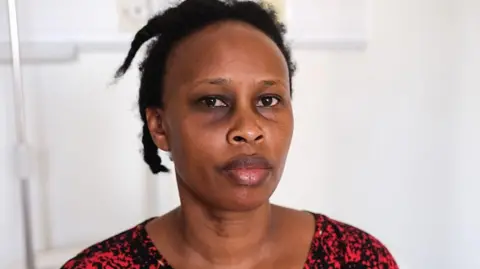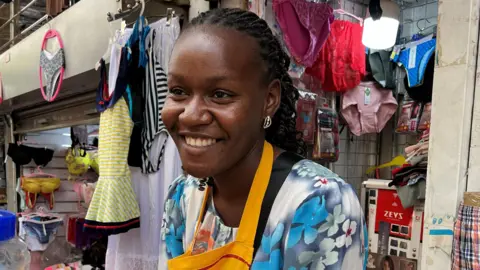
Mobile money agent Mirembe Tracy laments that her business in Uganda's bustling capital Kampala was paralysed when the government shut the internet during last week's fiercely contested general election.
All withdrawals were disconnected, she tells the BBC, adding that she gets nearly all of her income from withdrawal commissions.
Without it, her income dropped to zero.
In one week I can earn up to 450,000 [Ugandan] shillings (£96; $130). That money is what I use to pay rent. Losing it was a total loss, she says.
For two days either side of the election, there was nothing she could do but stay at home - she could only sell prepaid airtime credit, which she says does not give a commission.
Uganda's communications authority ordered the nationwide shutdown to ensure peace, protect national stability and prevent the misuse of communication platforms during a sensitive national exercise.
The opposition said it was a move to cover up voter fraud and stop its agents from sharing the results from polling stations.
Online businesses relied heavily on mobile money transactions and many came to a halt.
The co-founder of SafeBoda told local media that the platform's entire server was down during the internet suspension, with many riders forced off the road.
Namukwaya Olivia, a seller of traditional clothing who relies on social media for sales, struggled as her customers couldn’t access her online platforms.
Students faced challenges in communication, with online learning interrupted as teachers were unable to send notes and assignments.
Even journalists faced difficulties, as they were cut off from digitally reporting events, transforming their work into waiting and uncertainty.
As the internet has been partially restored, access remains slow for many, forcing users to employ VPNs to regain connectivity.