In brief
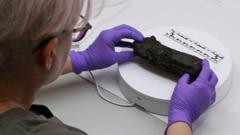
A badly burned and fragile scroll from the Roman town of Herculaneum has been digitally "unwrapped" for the first time in two millennia, thanks to innovative technology. The scroll, charred during the 79AD volcanic eruption of Mount Vesuvius, resembles a lump of coal and is too delicate for physical opening. However, a collaboration of X-ray imaging and artificial intelligence has allowed researchers to virtually unveil previously hidden rows and columns of text.
Led by Stephen Parsons as part of the Vesuvius Challenge, the project aims to unlock the secrets of the Herculaneum scrolls that were thought beyond reach. Initial scans have already revealed discernible letters and suggest the content relates to ancient philosophy. The already legendary scrolls were discovered in Herculaneum, buried alongside Pompeii. Due to their fragile condition, previous efforts to open them resulted in destruction. As stated by Nicole Gilroy, conservation head at Oxford's Bodleian Library, they previously lacked confidence that any technique would safely extract information from the scrolls. Therefore, the newfound promise of a hi-tech solution has sparked renewed interest in studying these historical artifacts.The scroll, containing approximately 10 meters of papyrus, was examined at Diamond Light Source, an advanced facility that emits powerful X-ray beams capable of offering a glimpse inside without causing damage. These high-resolution scans create 3D reconstructions of the scroll's structure, allowing experts to identify and digitally unroll the layers.The challenge now lies in using AI to distinguish between the carbon-based ink and the scroll itself, as both are nearly indistinguishable. The AI analyzes subtle signals to detect the ink, which is then digitally highlighted for clarity. Parsons expressed confidence in the potential to read the entire scroll, transitioning from mere words to significant passages soon.Last year's efforts yielded only about 5% readability of a different Herculaneum scroll predominantly featuring Epicurean philosophy. Experts expect this scroll will explore similar themes, with the team calling for further innovation in both human and computational realms to confirm this theory. For Gilroy, the project's implications connect them deeply with the ancient past, offering insights into the thoughts and experiences of those who created these texts. As she expressed, there’s an invaluable human connection embedded within these scrolls, emphasizing the cultural significance of this endeavor.