In brief
Groundhog Day is just around the corner, with Punxsutawney Phil set to make his annual weather prediction on February 2. The event, celebrated at Gobbler's Knob in Pennsylvania, draws huge crowds eager to see if Phil will see his shadow. Last year's forecast predicted six more weeks of winter, and the event has become a light-hearted celebration marking the halfway point between winter and spring.
The anticipation builds for the sunrise ceremony set to take place Monday when Punxsutawney Phil, the world-renowned groundhog, delivers his long-term weather forecast — signaling either six more weeks of winter or the arrival of early spring.
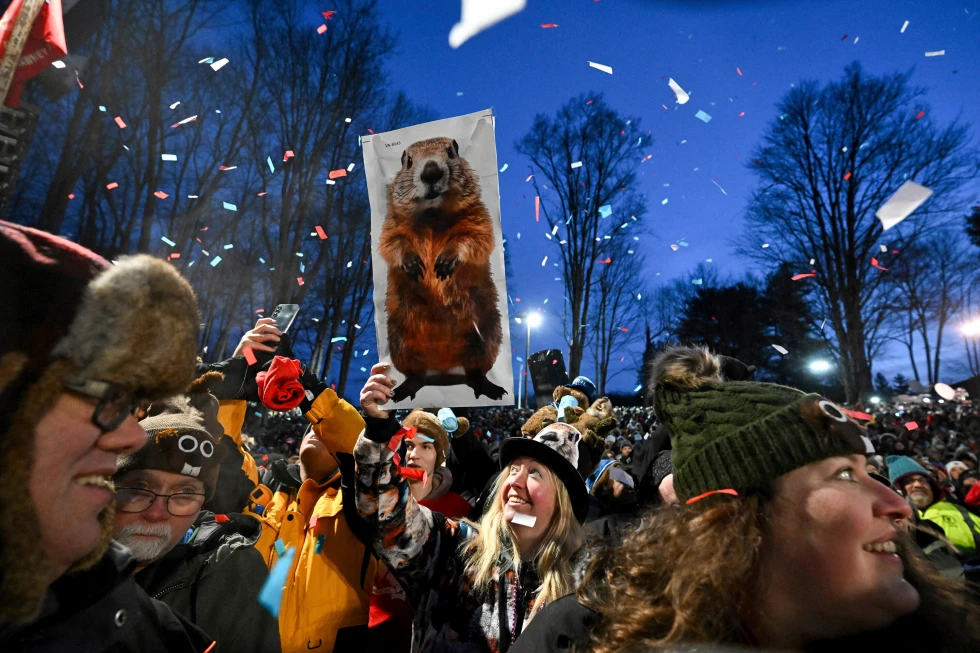
Throngs of enthusiastic fans are expected to gather at Gobbler’s Knob in rural Pennsylvania to witness this beloved annual tradition, where Phil will be brought out from his burrow onto a stage resting on a tree stump.
Last year, Phil predicted six more weeks of winter, a prognosis that aligns with his usual forecasts during early February. His handlers, part of the Punxsutawney Groundhog Club, interpret Phil's unique form of communication — composed of winks, purrs, and nods — to convey his predictions about the coming season.
Groundhogs, typically solitary animals, venture out in midwinter to seek mates. Should Phil fail to see his shadow, he is said to herald an early spring; conversely, if he does see it, more weeks of winter await.
This year marks Phil's debut at his new habitat at Gobbler’s Knob, where he resides when not at his long-standing home beside the town library.
Thanks to the iconic 1993 film 'Groundhog Day' starring Bill Murray, the event has gained tremendous popularity, transforming it into a cheerful morning festivity, although alcohol is no longer permitted on-site due to past incidents.
“Groundhog Day isn’t something to take seriously,” stated Dan McGinley, a long-time member of the Inner Circle of the Punxsutawney Groundhog Club. “We enjoy this lighthearted escape from the seriousness of life.”
Michael Venos, a dedicated chronicler of Groundhog Day traditions, shares insights into the humorous nature of the celebration. He recounts family traditions that include groundhog-themed cupcakes and a backyard prediction ceremony with sock puppets. Venos has documented over 300 similar events throughout history, showcasing the rich tapestry of groundhog-themed weather predictions across North America.
As Groundhog Day falls on February 2, it represents the midpoint of winter, situated between the solstice and spring equinox, while also intertwining with both Celtic traditions and the Christian holiday of Candlemas. It’s a festive occasion with deep cultural roots, dating back to German-American celebrations in the 1880s, evolving into the community event we see today.