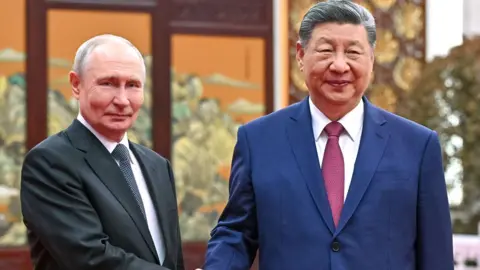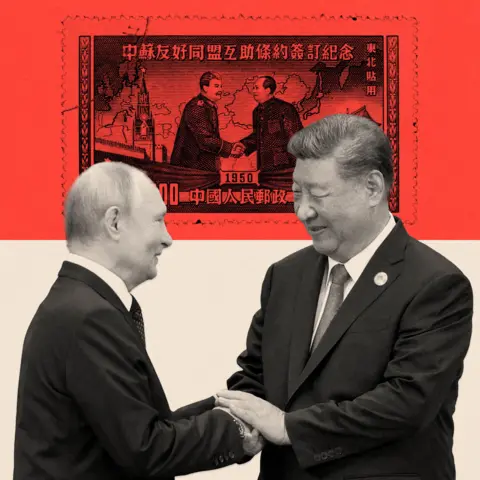
The bond between Chinese President Xi Jinping and Russian President Vladimir Putin is often viewed through a lens of mutual support and shared authoritarian values. A recent encounter at Tiananmen Square showcased their camaraderie, sparking discussions even on topics like organ transplants and human longevity.
Though both leaders describe one another as close friends, the relationship itself has layers of complexity. Alexander Gabuev from the Carnegie Russia Eurasia Center suggests that the relationship heavily favors China, stating, Russia is fully in China's pocket, and China can dictate the terms. This asymmetry plays a crucial role in shaping their interactions, particularly in economic sectors where China is Russia's largest trading partner, whereas Russia accounts for only a fraction of China's trade.
As Western sanctions on Russia tighten, the country has become increasingly reliant on China, even adopting Chinese technology in its military strategies. The ongoing conflict in Ukraine has heightened this dependence; reports reveal that Russia is sourcing over 90% of its sanctioned technology from China.
Despite the apparent imbalance, both nations maintain a partnership filled with strategic flexibility rather than a formal alliance. This adaptable framework allows both sides to navigate divergent interests while recognizing the importance of their relationship against the backdrop of a changing global order.
As both countries focus on economic and military cooperation, their shared interests, from energy supplies to defense technology, highlight the potential longevity of this partnership. While the future of Sino-Russian relations may hold uncertainties, analysts agree that for now, the bond remains resilient, crucial for both nations navigating an increasingly complex geopolitical landscape.