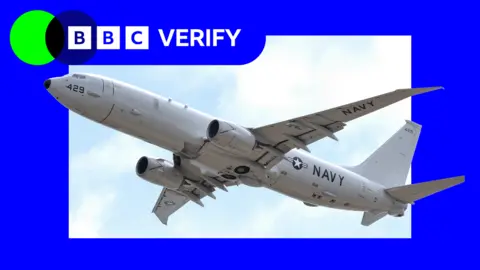
The U.S. military has been publicly broadcasting the location of military surveillance flights near Cuba on plane-tracking websites, as Washington continues to exert pressure on the island's communist leadership.
Leaving flight transponders on is likely deliberate, said UK drone expert Dr. Steve Wright, with the U.S. intending to send a clear message it has eyes in the sky to maintain the squeeze.
BBC Verify analysis of data from flight-tracking website Flightradar24 shows at least five U.S. Navy P-8A Poseidon surveillance aircraft and three MQ-4C Triton surveillance drones have been operating in the Caribbean near Cuba since May 11. Some aircraft have flown as close as 50 miles (80km) from the island.
Flight-tracking data cannot give a complete picture of U.S. activity off Cuba as military aircraft do not always broadcast their positions but share their location for portions of a flight.
The deployment of these aircraft comes as U.S.-Cuba tensions have risen significantly in recent months, after Washington imposed an effective oil blockade on the Caribbean nation.
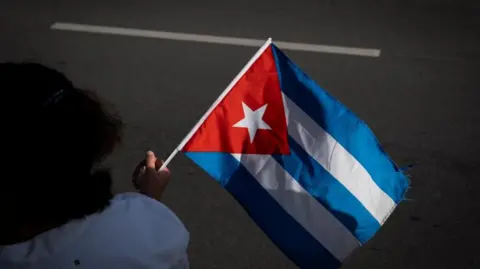
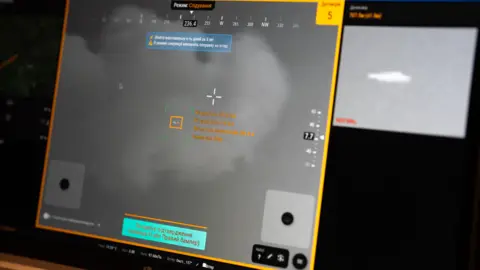
It has also been reported by news site Axios that Havana has acquired drones capable of attacking the U.S. mainland, which Cuba's foreign minister responded to by saying the country neither threatens nor desires war and accused Washington of building a fraudulent case for military intervention.
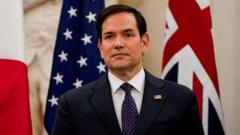
These accusations were followed by U.S. Secretary of State Marco Rubio offering a new relationship with the Cuban people. Speaking in Spanish on the anniversary of Cuba's independence from the U.S. in a direct address to the island's population, Rubio blamed the island's unimaginable hardships on its communist leadership - and not the U.S. fuel blockade.
Experts told BBC Verify the public nature of these surveillance flights indicates the U.S. is seeking to enforce the blockade and apply pressure on the Cuban government as well as deterring its allies like Venezuela from attempting to get energy shipments to the island.
The resulting fuel crisis has led to major power blackouts and triggered protests in Cuba. President Donald Trump has also put Cuba under significant pressure to make a deal and threatened its communist regime that the U.S. could intervene like it did in Venezuela earlier this year when it captured President Nicolás Maduro.
What the flight-tracking data shows
BBC Verify has tracked several flights by U.S. Navy P-8 Poseidon surveillance jets including one on May 11 when the aircraft got within 50 miles (80km) of southern Cuba, according to Flightradar24 data. The P-8 continued to operate into the following day, when it was seen flying to the north of Cuba's capital Havana before returning to its base in Jacksonville, Florida.
On May 15, two U.S. MQ-4C Triton surveillance drones also operated off the coast of southern Cuba, with tracking showing them operating along a route similar to one previously flown by a Poseidon.
Mark Cancian, a retired U.S. Marine Corps colonel and senior adviser at the Center for Strategic and International Studies (CSIS), told BBC Verify the recurrent flight paths of the surveillance aircraft indicate an intention to spot ship arrivals from the south, primarily, and secondarily from the north.
None of the flights are over land, so this is not some preparation for invasion, he said. Cancian added he doubts these flights are routine, given the number of P-8s and MQ-4C Tritons the U.S. has at its disposal are limited.
BBC Verify also examined U.S. military aircraft activity near Cuba between February 1 and 7, which saw only one P-8 fly in the vicinity of Cuba and no comparable MQ-4C Triton activity near the island. However, a U.S. Air Force RC-135V Rivet Joint reconnaissance aircraft did conduct two passes of the island over the period.
Drone expert Steve Wright told BBC Verify the drone surveillance flights are most likely part of a U.S. agenda to deter attempts by Venezuela to breach the oil blockade and ship fuel into Cuba.
Analysts from defense intelligence firm Janes offered a similar assessment, as well as saying there had been a general increase in U.S. intelligence, surveillance, and reconnaissance sorties since February.
The fact that these flights are visible through open-source tracking tools suggests they are intended to deter attempts to break the oil blockade and apply pressure on the Cuban government, Janes told BBC Verify.