In brief
President Donald Trump's attempts to acquire Greenland have met significant backlash within Congress, with a number of Republicans aligning with Democrats to express concern over the potential military and diplomatic repercussions. Despite Trump’s insistence on the strategic necessity of acquiring the territory, a bipartisan coalition in Congress is emerging to challenge his unilateral actions, emphasizing the need for adherence to international laws and respect for Greenland's sovereignty.
President Donald Trump's push to acquire Greenland has sparked a backlash from Republicans in Congress, as lawmakers voice growing concern about US military interventions overseas.
But it remains unclear if enough Republicans are willing to join Democrats to block a takeover of the island territory - and whether Trump would bow to pressure from Congress, or act alone as he's done several times in a second term marked by growing American entanglements abroad.
The focus on Greenland has grown into a broader discussion over the Trump administration's unilateral use of military force, along with diplomatic and economic coercion, to project power in Venezuela, Iran and elsewhere around the world.
Republicans have largely backed Trump's foreign policy agenda since he returned to the White House. But now, a growing number are siding with Democrats in Congress and NATO allies who say a takeover of Greenland would violate US and international law.
In recent days, some Republican leaders have said there's little interest in the US buying Greenland or seizing it through military force. The White House had previously left the military option on the table but on Wednesday it was ruled out by Trump in his speech at the World Economic Forum in Davos.
Some Republican lawmakers have also joined Democrats in opposing a new plan by Trump to place tariffs on countries that don't back his bid to acquire the territory, which is self-governed but controlled by Denmark.
The proposed tariffs would be bad for America, bad for American businesses, and bad for America's allies, Senator Thom Tillis of North Carolina wrote on social media, adding that the move would benefit China and Russia. It's great for [Russian President Vladimir] Putin, [Chinese President] Xi [Jinping] and other adversaries who want to see NATO divided.
Other Republicans said Trump's ambition to annex Greenland was threatening to undermine the NATO alliance - to which both the US and Denmark belong - in a moment of growing tension between the US and European allies.
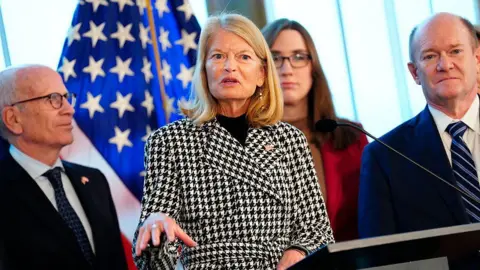
Respect for the sovereignty of the people of Greenland should be non-negotiable, Senator Lisa Murkowski, the co-chair of the Senate Arctic Caucus, said in a statement.
Trump has argued the US must own the territory to better compete with China and Russia in the Arctic, and has vowed to take it one way or another.
On Tuesday, the US president downplayed concerns that the issue was hurting NATO when asked by the BBC if he was willing to see the decades-old security alliance collapse as a consequence of his push for the territory. Trump reiterated his view that ownership of Greenland was critical for US and global security.
However, Trump's insistence on obtaining the territory is increasingly unpopular on Capitol Hill, as more Republicans have come forward to break ranks publicly.
Representative Don Bacon of Nebraska, a Trump critic, said Trump's push for Greenland could lead to an impeachment investigation. And the Republican leaders in each chamber of Congress, Senate Majority Leader John Thune and House Speaker Mike Johnson, said they opposed a military intervention in Greenland, when Trump was refusing to rule that out.
Other Republicans have voiced support for Trump. Senator Ted Cruz of Texas said it was overwhelmingly in America's national interest to own Greenland.
Congress has some options to try to rein Trump in, if Republicans and Democrats do choose to pick a fight with the president over Greenland.
Some Republicans have already indicated that they'd consider breaking with Trump over Greenland. Senator Mitch McConnell of Kentucky told reporters that a US takeover of the territory would shatter the trust of allies. Faced with growing Republican concern, Trump could look to strike a deal that falls short of a formal treaty and doesn't require Senate approval.