In brief
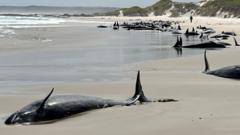
Authorities in Tasmania announced that more than 150 false killer whales, who have stranded near Arthur River, will be euthanized after attempts for rescue failed. About 90 survivors are in distress, and the difficult terrain hampers efforts for their return to the sea.
In a tragic event on a remote Tasmanian beach, over 150 false killer whales are set to be euthanized following a mass stranding. The whales were reported stranded near Arthur River in Tasmania's north-west by the Department of Natural Resources and Environment. While around 90 of the 157 animals were found alive, experts on-site noted that complex circumstances made rescue efforts unfeasible.Mass strandings in Tasmania are not uncommon, with the island having witnessed its worst incident in 2020; however, false killer whales haven’t experienced such an event in over fifty years. As one of the largest dolphin species, the false killer whale can measure up to 6 meters (19 ft) and weigh up to 1.5 tonnes.Witnesses reported that the pod had been stranded for 24 to 48 hours, putting further strain on the surviving animals. Local resident Jocelyn Flint expressed her horror, describing the whales looking to her for help. The beach site's inaccessibility only complicated rescue efforts, highlighted by marine biologist Kris Carlyon.With challenging terrain and rough weather expected to continue, expert teams attempted to relocate and refloat two whales but were ultimately unsuccessful. Dr. Carlyon of Tasmania’s Parks and Wildlife Service stated that the prolonged stranding resulted in suffering for the animals, leading to the difficult decision to proceed with euthanasia—a last resort.The euthanasia process is expected to commence soon, with the disposal of the carcasses presenting another dilemma, particularly due to the site’s cultural significance to Aboriginal communities. Authorities have advised the public to stay away from the area, also affected by nearby bushfires. Tasmania experiences over 80% of Australia’s whale strandings, often impacting close-knit groups due to their social nature. The reasons for such beachings are still being studied, with theories ranging from hunting behaviors to disorientation.