In brief
Japanese researchers are testing wood's durability in space, potentially transforming future exploration on the Moon and Mars.
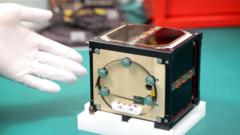
The world's first wooden satellite, named LignoSat, has been successfully launched into orbit to study the viability of timber as a sustainable material for future space exploration. Weighing a mere 900 grams, it is part of a SpaceX mission and will ultimately be deployed from the International Space Station. Constructed from magnolia wood using traditional techniques that avoid screws and glue, LignoSat reflects a significant shift towards renewable resources in aerospace technology. The satellite's significance lies not just in its innovative materials but also in the research agenda it supports. According to Professor Koji Murata from Kyoto University, wood can be more durable in the harsh conditions of space compared to Earth, as it won't succumb to the rot or fire typically caused by water and oxygen. He notes that early aviation utilized wooden structures and believes that a wooden satellite could similarly thrive in orbit. Researchers envision a future where trees could be cultivated on the Moon or Mars, offering essential resources for human colonies. Incorporating traditional aluminum components alongside its wood panels, LignoSat is equipped with sensors to monitor how the wood withstands extreme space conditions. Dr. Simeon Barber, a space scientist from the Open University, acknowledges that while wood is not the sole component, the concept of using it in space is intriguing, primarily due to its renewability. The hope is to eventually utilize wood cultivated on other planets for both construction and shelter, reminiscent of early explorers using wood in new lands. While wood has previously been used in aerospace—primarily for cork in protective layers—there are challenges associated with using it in critical spacecraft structures due to unpredictable strength properties. Additionally, while wood might offer a less polluting alternative when spacecraft burn up upon re-entry, scientists like Dr. Barber express concern about the potential need to carry extra material, which could increase overall weight. As the satellite project unfolds, Kyoto University researchers remain optimistic about replacing some metallic components with wood as a step towards more sustainable space exploration practices, while highlighting the need for careful consideration of engineering challenges.