In brief
With President Emmanuel Macron's recent announcement to recognize Palestinian statehood at the upcoming UN General Assembly, the spotlight has shifted onto Sir Keir Starmer and the UK government's stance. France's long-desired recognition comes as a counterpoint to the UK’s traditional hesitance rooted in historical policy and diplomatic caution. As parliamentarians increasingly advocate for recognition, the UK faces a pivotal moment that could reshape its foreign policy and relations with allies.
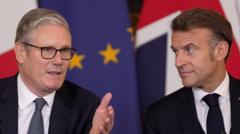
The article text:In a bold diplomatic move, President Emmanuel Macron of France has announced his intention to recognize Palestinian statehood, setting the stage for potential change in international relations. The decision, anticipated to be formalized during the United Nations General Assembly in September, intensifies pressure on UK Prime Minister Sir Keir Starmer to consider a similar commitment.France has long sought to take this significant step, having planned the announcement weeks prior, but delays occurred due to geopolitical tensions following attacks on Iran’s nuclear facilities by Israel and the US. The French government's hope is to foster momentum for recognition and encourage other nations to join them in acknowledging Palestinian sovereignty.Macron's assertions during his recent visit to the UK emphasized the need for collaboration between France and the UK as both are permanent members of the UN Security Council. A senior French diplomat remarked that UK involvement could potentially persuade other states to break diplomatic silence, suggesting that such cooperation would demonstrate a serious commitment to achieving peace in the region.However, the British government has historically been cautious regarding the recognition of Palestinian statehood. Officials argue that such a declaration should serve a constructive role in negotiations rather than be interpreted as a mere gesture. There is a prevailing belief that recognition should not be hastily undertaken, especially when it could upset crucial allies like the US and Israel, who view it as a concession to perceived aggression from Palestinian factions.The current UK leadership maintains that recognizing a Palestinian state must align with broader political goals, including a ceasefire. Prime Minister Starmer’s recent comments underscored that peace must precede any recognition, emphasizing a two-state solution that ensures security for Israelis while recognizing Palestinian rights.As internal and external pressures mount, the UK government finds itself at a crossroads. Within Parliament, there is a growing chorus of voices advocating for a shift in policy toward recognition. The Foreign Affairs Committee and retired diplomats have penned letters urging immediate recognition, while Cabinet members like Health Secretary Wes Streeting have hinted at the urgency of the situation, suggesting that recognition must happen "while there is a state of Palestine left to recognize."The risk now lies in the potential fallout if the UK fails to align with France's leading position. Should the British government choose not to act, it could face significant backlash in Parliament, threatening unity within its ranks. If recognition occurs begrudgingly, it raises questions about the diplomatic efficacy of such a move.With more than 140 countries having recognized Palestine already, including recent additions like Ireland and Spain, the implications of future declarations remain uncertain in terms of tangible benefits for those affected in the ground realities of Gaza. The unfolding situation presents a critical juncture for the UK as it grapples with its foreign policy stance amid changing international dynamics.