In brief
The Parker Solar Probe is set to perform the closest ever swing by the Sun, gathering crucial data about its outer atmosphere under intense heat and radiation.
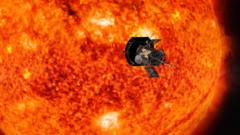
The NASA Parker Solar Probe is gearing up for a record-setting pass near the Sun, marking a groundbreaking mission as it dives into our star's outer atmosphere. Set to experience extreme temperatures and relentless radiation, the spacecraft will go silent for several days during this daring fly-by, with scientists eagerly awaiting a signal confirming its safe passage, expected on December 27.Dr. Nicola Fox, NASA's head of science, emphasized the importance of directly studying the Sun's atmosphere, stating, "For centuries, people have studied the Sun, but you don't experience the atmosphere of a place until you actually go visit it." The Parker Solar Probe, launched in 2018, has already completed 21 orbits around the Sun, but this upcoming Christmas Eve encounter will position it just 3.8 million miles (6.2 million kilometers) from the solar surface—a significant milestone.To put this distance in perspective, Fox explained, "If the Sun and the Earth were one meter apart, Parker Solar Probe would be just four centimeters from the Sun." The probe will endure scorching temperatures of 1,400 degrees Celsius and intense radiation that could damage its onboard electronics. Fortunately, it's equipped with a robust 4.5-inch thick carbon-composite shield and aims to execute a rapid fly-by, moving at a staggering speed of 430,000 miles per hour, comparable to traveling from London to New York in less than 30 seconds.The mission is particularly dedicated to uncovering the mysteries of the Sun's corona—its outer atmosphere—which exhibits unexpectedly high temperatures reaching millions of degrees, far hotter than the Sun's surface. Dr. Jenifer Millard, an astronomer involved with the project, described the need for understanding why the corona is so much hotter despite being farther from the Sun.In addition, the Parker Solar Probe's research will also shed light on solar wind, the stream of charged particles that can impact Earth's magnetic field, leading to beautiful auroral displays but also potential disruptions to power and communication systems. As the spacecraft maneuvers into this challenging environment, NASA scientists are on edge, waiting for the first signals confirming its safe return. Fox reassured that the spacecraft is designed to survive harsh conditions, highlighting its resilience, "It's a tough, tough little spacecraft."