In brief
The article highlights the grim aftermath of a devastating earthquake in Mandalay, Myanmar, where the destruction is vast, and the aid is scarce. Witnesses share harrowing accounts of loved ones trapped under rubble, while the political turbulence hinders effective rescue and relief operations. As families grapple with loss and hope, they face overwhelming challenges amid oppressive military oversight.
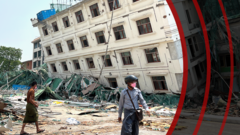
Driving into Mandalay, the horrific aftermath of Friday's earthquake slowly revealed itself to us. Each turn down major roads unveiled buildings reduced to piles of rubble and streets filled with dangerous, cracked structures, rendering them unsafe for residents. Even the city's main hospital has moved treatments outdoors, signifying the extent of the crisis. Since the quake, Myanmar's military government has barred foreign journalists from entering the country, compelling us to conduct our reporting under disguise due to the pervasive risk of being monitored by informers or secret police. The struggle for survival is palpable, with little help reaching those afflicted. A mother, Nan Sin Hein, tells of her 21-year-old son, Sai Han Pha, trapped within a collapsed five-storey tower where he was working. "I hold onto hope, no matter how slim," she declares, awaiting news on the rescue efforts that seem painfully delayed. The building's upper levels lean precariously, increasing the danger for any potential rescues.In the wake of the tragedy, rescue operations are sporadic across the city, focusing primarily on significant collapse sites like high-rise condos and a Buddhist academy where hundreds had gathered for an exam when disaster struck. An Indian disaster response worker describes challenges akin to a "pancake collapse," with the likelihood of finding survivors shrinking by the hour. As temperatures soar to near 40C, rescuers utilize metal drills and hydraulic cutters to sift through the debris, unearthing the grim reality of human loss. We witness the strained faces of families clinging to hope as they crowd around ambulances bearing recovered bodies, struggling to identify their loved ones amidst the devastation.The Myanmar military claims nearly 2,900 casualties, but the sheer number of unaddressed collapse sites suggests the real toll could be catastrophic. With parks transformed into makeshift camps, and families sleeping outside for safety after countless aftershocks, the city's atmosphere now brims with fear and uncertainty. Elderly residents, like 72-year-old Daw Khin Saw Myint, lament their losses as they line up for water securely under the remnants of their homes. "I’m living under a tree," she shares, revealing widespread despair among those affected, noting that aid distribution remains inadequate and scrappy.Makeshift treatment areas emerge in hospitals, affected by structural damage and overwhelmed with the desperate need for medical professionals. We observe residents stepping in to contribute care in the absence of adequate medical staff. The urgency grows as the window for finding survivors narrows each day.As Nan Sin Hein clings to the hope of seeing her son, even in death, the reality of loss becomes increasingly imminent. "I am heartbroken," she admits, "I want to see him, to know he fought for us." The ongoing rescue challenges against a backdrop of political suppression continue to exacerbate an already dire humanitarian crisis in Mandalay.