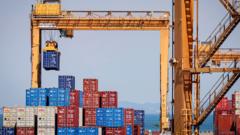
The World Trade Organization (WTO) has issued a stark warning that global trade is expected to decline this year as a direct consequence of tariffs imposed by US President Donald Trump. The organization indicated that "severe downside risks," such as reciprocal tariffs and political instability, could contribute to a more pronounced decrease in the exchange of goods internationally, especially in North America where trade could drop by over 10%.
WTO Director-General Ngozi Okonjo-Iweala expressed serious concern over the "decoupling" of the US and China, describing it as a "phenomenon that is really worrying." Initial expectations for a 2.7% global goods trade growth by 2025 have now been revised down to a contraction of 0.2%. Chief economist Ralph Ossa underlined the widespread and often unintended consequences of tariffs, indicating that trade policy uncertainty significantly dampens export activities.
Additionally, the UN trade and development body, UNCTAD, has projected a slowdown in global growth to 2.3% in 2025, pushing it below the 2.5% threshold often associated with a global recession, largely due to escalating trade tensions.
The imposition of a baseline tariff of 10% on nearly all foreign imports to the US, effective since April 5, has exacerbated trade concerns. While the US stock market reacted negatively to this uncertainty, the WTO forecasts potential growth in exports and imports for regions like Asia and Europe, suggesting that not all parts of the globe will suffer equally from these tariff policies.
For the first time, the WTO report included forecasts for services trade, projecting a 4% increase by 2025, despite being lower than previous expectations. President Trump's tariff policies, aimed at promoting domestic production and investment, have faced criticism for their complexity and the long-term impact on the economy. Moreover, Trump has frequently altered his stance on tariffs, indicating a 90-day pause on certain trade penalties just hours after implementing them, leading to further market volatility.
Economic analysts caution that the long-term effects of these tariffs could necessitate decades of restructuring for US manufacturing, with potential short-term consequences for consumers and the broader global economy.