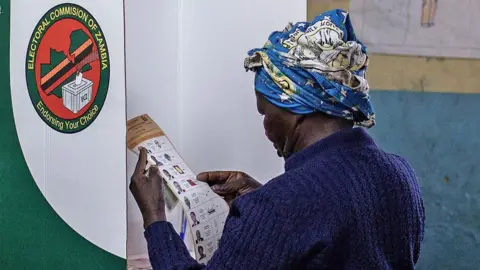
A senior Zambian government official has said that some political parties were asking prospective female candidates for sexual favours in exchange for selection ahead of August's general election.
'I am going to appeal to all female aspiring candidates to ensure that they record all these cases,' Mainga Kabika, the civil service head of the gender division in the president's office, stated. She did not name the political parties involved.
Zambia has a significant gender imbalance in national politics, with only around 15% of MPs being women. This under-representation is said to stem from 'deep-rooted cultural and structural barriers,' according to a statement from the presidency.
Kabika, while addressing state prosecutors, revealed that she had been contacted by multiple women regarding these demands. 'I can confirm that I am receiving a lot of messages; some of them are already on record,' she remarked, expressing that the situation is unacceptable and discourages women's political participation.
Beauty Katebe, chair of the Non-Governmental Gender Organisations Coordinating Council, echoed these concerns, noting that many aspiring female politicians experience 'sextortion' during the nomination process. She urged those affected to report such incidents while acknowledging the cultural biases and stigmas that may hinder them from doing so.
Katebe also called for a fast-track court to address allegations promptly and suggested that stricter laws be established to deter sexual harassment in politics. 'If they were exposed, they would definitely stop,' she argued, stressing that the patriarchal structures within political parties are detrimental to women's participation.
Despite some appointments of women in high-profile political roles, the president's office acknowledged that there remains substantial work to be done in achieving gender parity, with only 28% of civil service directors being women, and a disturbing statistic showing that among 36 state-owned enterprise CEOs, only five are female.
The general elections in Zambia are scheduled for August 13, where citizens will vote for a president, MPs, councillors, and council chairs.
'I am going to appeal to all female aspiring candidates to ensure that they record all these cases,' Mainga Kabika, the civil service head of the gender division in the president's office, stated. She did not name the political parties involved.
Zambia has a significant gender imbalance in national politics, with only around 15% of MPs being women. This under-representation is said to stem from 'deep-rooted cultural and structural barriers,' according to a statement from the presidency.
Kabika, while addressing state prosecutors, revealed that she had been contacted by multiple women regarding these demands. 'I can confirm that I am receiving a lot of messages; some of them are already on record,' she remarked, expressing that the situation is unacceptable and discourages women's political participation.
Beauty Katebe, chair of the Non-Governmental Gender Organisations Coordinating Council, echoed these concerns, noting that many aspiring female politicians experience 'sextortion' during the nomination process. She urged those affected to report such incidents while acknowledging the cultural biases and stigmas that may hinder them from doing so.
Katebe also called for a fast-track court to address allegations promptly and suggested that stricter laws be established to deter sexual harassment in politics. 'If they were exposed, they would definitely stop,' she argued, stressing that the patriarchal structures within political parties are detrimental to women's participation.
Despite some appointments of women in high-profile political roles, the president's office acknowledged that there remains substantial work to be done in achieving gender parity, with only 28% of civil service directors being women, and a disturbing statistic showing that among 36 state-owned enterprise CEOs, only five are female.
The general elections in Zambia are scheduled for August 13, where citizens will vote for a president, MPs, councillors, and council chairs.