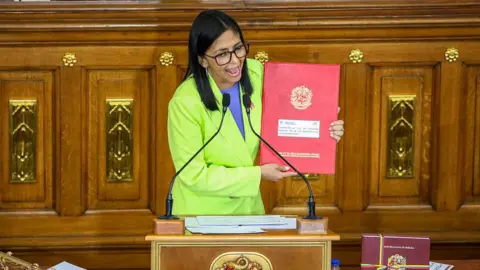
Venezuela's interim president Delcy Rodríguez has proposed new oil reforms in her first state of the union address since former president Nicolás Maduro was seized by the US. Rodríguez said she wanted to reform the law that limits foreign involvement in the country's oil industry - a move away from Maduro's policies. She said she was not afraid to face the US 'diplomatically through political dialogue,' adding Venezuela had to defend its 'dignity and honour'. President Trump has suggested that US oil companies could move into Venezuela and generate funds for both Venezuelans and the US, while a top official indicated that the US would control sales of sanctioned Venezuelan oil 'indefinitely'. Trump has also requested at least $100 billion in investment from oil companies, but executives have expressed concerns about the current investment climate. Rodríguez, who took office on January 5 following Maduro's detention, indicated her willingness to travel to Washington for discussions with Trump. She unveiled plans for two sovereign funds aimed at boosting social welfare and infrastructure amidst Venezuela's ongoing economic crisis, stressing the importance of national unity in facing external threats.
Venezuela's Interim President Unveils Ambitious Oil Reform Plans
Venezuela's Interim President Unveils Ambitious Oil Reform Plans
In her first address since assuming power, Delcy Rodríguez proposes significant changes to the country's oil legislation, aiming to attract foreign investment and shift from previous policies.
Delcy Rodríguez, Venezuela's interim president, has proposed reforms to the country's hydrocarbon law during her inaugural state of the union address. These reforms are designed to allow greater foreign participation in the oil sector, moving away from former president Maduro's restrictive policies. The proposals come in the context of a strained economy and political landscape following the US operation that removed Maduro from power. Rodríguez emphasized the need for national unity and diplomacy with the US, which has shown interest in Venezuelan oil investment.