In brief
U.S. President Donald Trump hosted a significant summit where leaders from the Democratic Republic of Congo and Rwanda signed a peace deal aimed at resolving longstanding conflicts. Despite prior escalations and ongoing tensions, the ceremony at the Trump Institute of Peace hopes to pave the way for future cooperation and investments in the resource-rich region. Both nations' leaders emphasized their commitment to the agreement, as concerns over rebel activities and distrust persist.
The leaders of the Democratic Republic of Congo and Rwanda have signed a peace deal aimed at ending the long-running conflict in the region at a summit hosted by US President Donald Trump in Washington.
Ahead of the summit, there was an escalation in fighting in resource-rich eastern DR Congo between government forces and rebels believed to be backed by Rwanda.
DR Congo's army accused its rivals of attempting to sabotage the peace process, but the M23 rebels said the army had launched an offensive in breach of a ceasefire.
At the start of the year, the M23 seized large parts of eastern DR Congo in an offensive that saw thousands killed and many more forced from their homes.
At the beginning of the event at the newly-renamed Donald J Trump Institute of Peace, Trump said the peace ceremony was a great day for Africa and the world.
I have a lot of confidence in both leaders, Trump added. We'll keep these commitments. I know they're going to keep them and follow through on the agreement and create a much brighter future for the people of their countries.
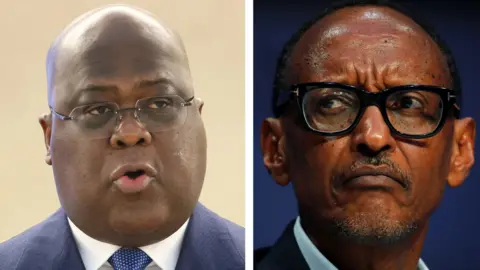
DR Congo's President Felix Tshisekedi and his Rwandan counterpart Paul Kagame have frequently exchanged insults in recent years, each accusing the other of starting the conflict.
Trump got the two countries' foreign ministers to sign a peace accord in June, hailing it as a glorious triumph.
Tshisekedi and Kagame have now endorsed it, as have a number of other African leaders who attended the signing ceremony, including those from Kenya, Angola, Burundi and Togo, as well as the vice-president of Uganda.
At the event, Kagame praised Trump as an even-handed leader who is never taking sides. Kagame described Trump's approach as pragmatic and said that as a result, we have the clearest and most viable path forward that we have ever had.
Tshisekedi expressed deep gratitude and clear hope, while at the same time saying he hoped Rwanda will respect the letter and spirit of the deal.
The foreign ministers of Qatar and the UAE also were in attendance, as was US Secretary of State Marco Rubio.
The M23 was not present - it is in talks with DR Congo's government in a parallel peace process led by Qatar.
The Trump administration spearheaded talks between DR Congo and Rwanda, hoping that resolving the differences between the two neighbours would pave the way for the US to increase investments in the resource-rich region.
At the signing ceremony, Trump said the US will send some of our biggest and greatest companies over to the two countries. Trump emphasized, And we're going to take out the rare earth, take out some of the assets, and pay. Everybody's going to make a lot of money.
Rwanda denies supporting the M23, despite UN experts saying its army is in de facto control of M23 operations.
Some analysts are skeptical about whether the deal will lead to lasting peace.
A DR Congo researcher with the South Africa-based Institute for Security Studies think-tank, Bram Verelst, told the BBC that there was currently no ceasefire in place, and the M23 rebellion continues to expand and consolidate its control.
Fresh fighting was reported on Thursday, while on Tuesday, DR Congo army spokesman Gen Sylvain Ekenge said the rebels had launched a fresh offensive on villages in the South Kivu province.
Kagame insists that the FDLR must be disarmed, while DR Congo demands the withdrawal of Rwandan troops from its territory.
However, several deals going back to the 1990s have failed after Rwanda accused previous Congolese government of failing to disarm the FDLR, and this remains one of the main stumbling blocks in current efforts to end the conflict. Both of these conditions are included in the peace deal to be signed in Washington.
With ongoing tensions, only time will tell if the peace deal will succeed in bringing lasting stability to the region.