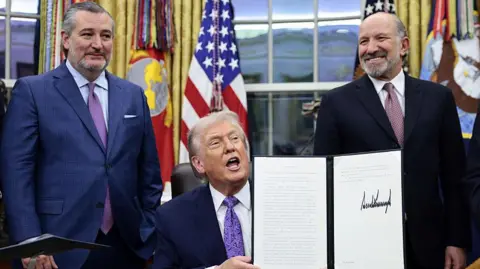
US President Donald Trump has signed an executive order aimed at blocking states from enforcing their own artificial intelligence (AI) regulations.
We want to have one central source of approval, Trump told reporters in the Oval Office on Thursday.
This order will equip the Trump administration with tools to address the most onerous state regulations, according to White House AI adviser David Sacks, who indicated exceptions may be made regarding AI regulations around children's safety.
This directive represents a victory for technology giants seeking uniform AI legislation nationwide, essential for maintaining leadership in the rapidly evolving sector.
Many AI company leaders argue that varying regulations at the state level could stifle innovation, particularly as the US competes against China for dominance in AI, with substantial investments flowing into the technology sector.
However, the announcement has sparked opposition, notably from California, home to many major tech firms, which has its own established AI regulations. Governor Gavin Newsom condemned the executive order, labeling it as corrupt and detrimental to the protection of Americans from unregulated AI technologies.
Earlier this year, Newsom endorsed a bill mandating leading AI developers to devise strategies to mitigate risks posed by their AI systems.
Other states, including Colorado and New York, have enacted laws governing AI development, and Newsom's stance advocates for a model that could guide federal legislation.
Critics argue that Trump's executive order encroaches upon states' rights to safeguard their residents and may lead to inadequate federal oversight.
Michael Goodyear, an associate professor at New York Law School, commented on the necessity for coherent federal laws as opposed to a confusing array of state regulations, showing concern that the package, if poorly designed, could exacerbate issues.
Conversely, the tech lobby group NetChoice celebrated the executive order, expressing optimism about collaborating with the White House and Congress to establish nationwide standards for AI.