In brief
About 90 false killer whales will be euthanised following a mass stranding in Tasmania as efforts to rescue them prove unsuccessful.
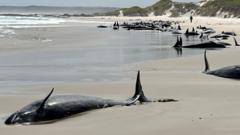
Authorities in Tasmania have initiated euthanasia for approximately 90 false killer whales that survived a recent mass stranding on a remote beach in the north-west of the island. The whales beached near Arthur River, part of a pod of 157, with the majority succumbing shortly after the incident. Rescuers stated that the complex conditions surrounding the stranding had rendered the chances of saving the remaining whales nearly impossible. This incident marks a significant event, as Tasmania has not seen a mass stranding of false killer whales for over half a century, despite other mass stranding events occurring in recent years. These marine mammals, larger relatives of dolphins, can reach lengths of up to 6 meters and weigh as much as 1.5 tonnes. Local resident Jocelyn Flint expressed her heartache after visiting the site, describing the sight of stranded whales, some of which were young. “It’s just absolutely horrific,” she added, relaying the stress the whales displayed as they looked for help. The area is challenging to access due to its rough terrain, making it difficult to transport rescue equipment and rescue the whales. Marine biologist Kris Carlyon noted the site’s inaccessibility heightened the difficulty faced by the rescuers. Efforts to refloat the trapped animals failed as they could not navigate past the surf to return to deeper waters. In light of the harsh conditions and ongoing stress experienced by the surviving whales, wildlife vets collectively concluded that euthanasia was the only viable option left, highlighting that such measures are always a last resort. As the grim task of euthanising the whales commenced, authorities faced logistical challenges regarding the disposal of the carcasses, given the site holds significant cultural heritage for the Aboriginal people. Tasmania experiences a high rate of whale strandings, with over 80% of such incidents occurring in its waters, primarily along the west coast. In 2020, around 470 pilot whales stranded in nearby Macquarie Harbour, with the majority failing to survive despite rescuers’ interventions, further underscoring the challenges associated with aiding these maritime mammals.