In brief
Thousands gathered in Gaza City to lay final respects to 112 men, women and children lost in an Israeli strike on a residential building in November 2023. The remains, recovered by Gaza’s Civil Defence with ICRC aid, were placed in rows and covered with Palestinian flags and family photographs before relatives pulled them away. The funeral, the largest of its kind in Gaza, underscored the ongoing toll of the Gaza war, with over 73,000 civilians confirmed dead.
Mass funeral mourns 112 dead in Gaza
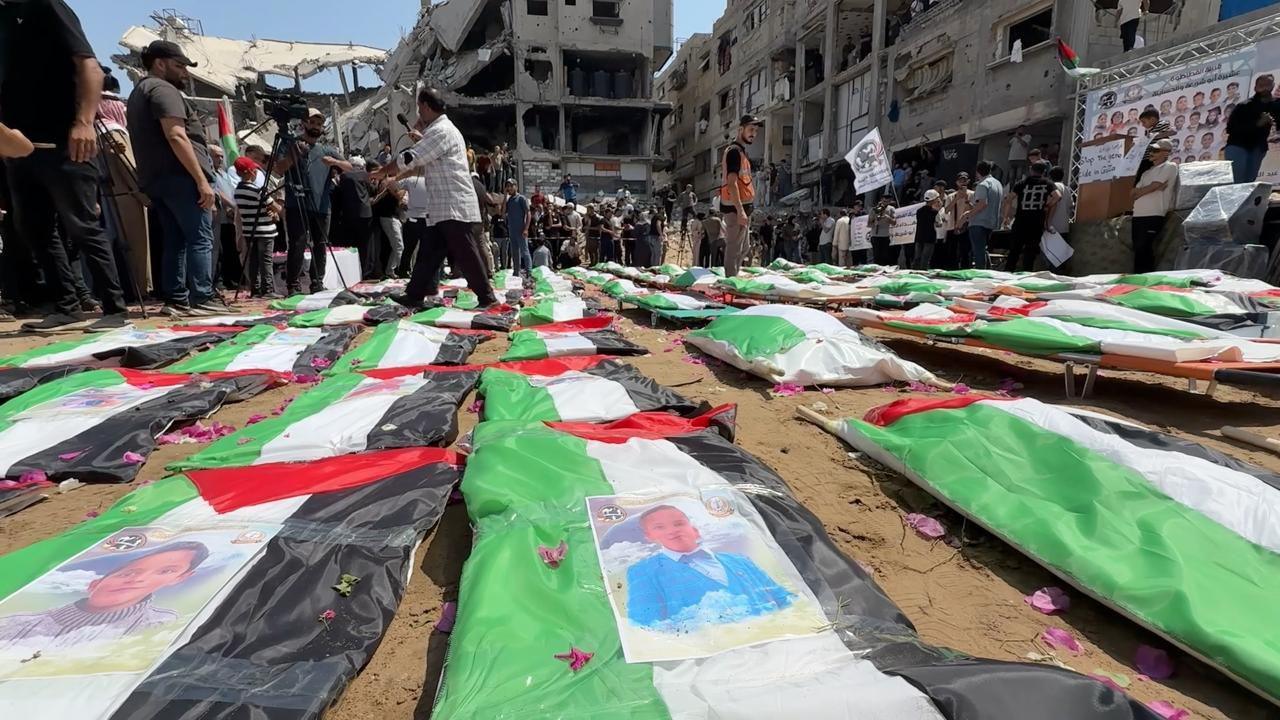
A huge crowd gathered in Gaza City on 4 August to hold the biggest funeral in the region, marking the loss of 112 civilians — mainly women and children — who were killed during an Israeli air strike on a residential block in the Sabra neighbourhood on 22 November 2023.
The graves were uncovered after a two‑week rescue operation conducted by the Civil Defence, a body that works under the Hamas‑run interior ministry. International support from the International Committee of the Red Cross brought tools, protective gear and body bags, and even rented excavators to aid the painstaking work of digging out the bodies from beneath rubble.
Families lined up the recovered remains in rows, each wrapped with a Palestinian flag and sometimes a photograph of the deceased. The scene, captured on film, shows relatives taking the bodies away for burial, a gesture that offers a moment of closure amid the ongoing violence.
Ali Abu Sharia, one of the mourners, said: "I think this is a feeling that was supposed [to be felt], a feeling of pain, grief and loss. After we managed to retrieve them and bury them, perhaps we can be partially relieved, despite the pain of loss and all we’re still living through."
The victims represented two extended families, the Abu Sharia and Hassayna clans, whose loss includes 44 children, 38 women and seven people with disabilities. The Sabra strike was one of many heavy bombardments during the six‑week war that began after the Hamas‑led assault on Israel on 7 October, which saw 1,200 people killed and 251 taken hostage in southern Israel.
The Gaza Health Ministry, whose figures are considered reliable by the United Nations, reports that at least 73,377 people have been killed in the strip since the war began. The recovery operation at Sabra suggests that dozens more bodies may yet be found under the rubble. Thousands more civilians remain unaccounted for across the Gaza Strip.
The Civil Defence’s spokesperson, Mahmoud Basal, warned that on the day of the strikes the crew couldn’t reach the site immediately due to the need for coordination with Israel and the danger of the area. He later remarked that roughly 90% of the civilians inside the leveled multi‑storey building were killed.
Neighbors who survived the bombing described the scene in the living room where the rubble lay, holding items such as a backpack and shoes as proof of the loss. “I lost my mother, father, uncle and cousins,” Yousef Abu Sharia told reporters after the funeral. “I am the sole survivor of my family,” he added.
The mourning event underscored the continued toll of the Gaza war, where new discoveries of casualties are still being made amid ongoing humanitarian crises. It also highlighted the crucial roles of local rescue teams and international humanitarian organisations in providing support to families during their darkest moments.