In brief
A magnitude 7.5 earthquake hit north-eastern Japan, injuring at least 30 people and forcing the evacuation of around 90,000 residents. The quake disrupted train services and left many without power. Concern remains over the possibility of stronger aftershocks in the days ahead as authorities coordinate disaster response efforts.
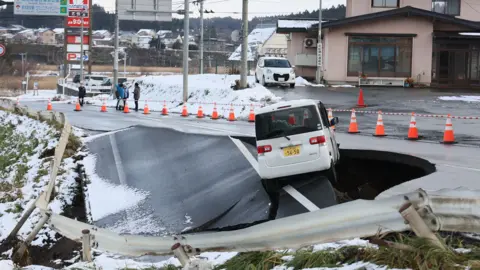
At least 30 people were injured after a magnitude 7.5 earthquake hit north-eastern Japan on Monday night, forcing thousands of people to evacuate their homes. The quake occurred at 23:15 (14:15 GMT) at a depth of 50km (31mi), about 80km off the coast of the Aomori region, the Japan Meteorological Agency said. It prompted tsunami warnings which have now been lifted, while waves of 70cm (27in) were seen. Some train services have been suspended and thousands of homes have been left without power as a result. Authorities have also warned that a stronger tremor could occur in the coming days - urging the public to remain on high alert for at least a week, according to local media reports.Japanese Prime Minister Sanae Takaichi addressed the citizens affected by the earthquake, emphasizing the importance of earthquake preparedness and the necessity to evacuate immediately if shaking is felt. Evacuation orders were issued for about 90,000 residents, and the Aomori prefectural government reported that around 2,700 homes have lost power. In response to the situation, the Japanese government has activated a response office within the prime minister's crisis management center, and Chief Cabinet Secretary Minoru Kihara stated that every effort is being made to assess damage and implement emergency measures.Fortunately, nuclear power plants in the region reported no irregularities following the quake, with no issues noted at the disabled Fukushima nuclear station, which had been previously damaged by the more powerful 9.0 magnitude earthquake in 2011. As one of the world’s most earthquake-prone nations, Japan is on high alert as seismic activity continues in the area, with predictions indicating a significant risk for future megathrust earthquakes.