In brief
"In Gaza, reports indicate growing desperation among families as the blockade continues to restrict vital access to food and medical supplies. Affected families describe their struggles, with children left hungry and adults resorting to desperate measures for survival. Amidst warnings of impending famine, humanitarian conditions remain dire, raising alarm throughout the international community."
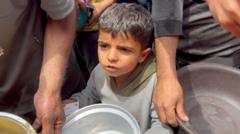
As crowds crowded around a food distribution center in northern Gaza, six-year-old Ismail Abu Odeh squeezed his way to the front. “Give me some,” he pleaded, while clutching an empty bowl. His small bowl was briefly filled with lentils, but as he turned to leave, it was knocked from his hands. Crying, he returned to his family’s tent, only to find that later, his uncle could share some food with him. The following day, however, no water or food reached the displacement camp where he lived, situated in a school in Gaza City, leaving the residents with empty bottles and bowls.The BBC has recently been communicating with Gazans amidst increased military actions from Israel, combined with a total blockade lasting more than ten weeks that restricts food, medical care, and other essential aid. The United Nations warns that the humanitarian situation in the enclave is approaching famine levels. In response, the Israeli government maintains that there is "no shortage" of food within Gaza, alleging that Hamas is looting and selling the aid intended for civilians. Tensions rise as Israeli ministers describe the cessation of aid as a "main pressure lever" aimed at defeating Hamas and securing the release of hostages, of which about 58 remain in captivity, with 23 believed alive.Due to restricted access for international journalists, much of the information about these humanitarian issues has been gathered via phone and WhatsApp communications with reliable local sources. Many residents report severe difficulties in obtaining even a single meal daily, as food kitchens close down due to dwindling supplies, and items remaining in shops come at exorbitantly inflated prices. A local man managing one of the remaining food kitchens expressed that he was operating "on a day-to-day" basis to secure resources like food and oil. Another volunteer shared that his kitchen had closed ten days ago, leaving him with a sense of despair.Adham al-Batrawi, 31, previously from the affluent al-Zahra, now displaced in central Gaza, described the torment of hunger as a daily burden. He explained how he had to “get creative” just to eat, demonstrating resourcefulness in his cooking. Having reduced his meals to once a day, he still admitted that what he consumed fell drastically short of his energy needs. Within that context, a 23-year-old woman in north Gaza shared that she experiences constant dizziness and fatigue linked to severe shortages of both food and medicine.In the city of Deir al-Balah, Rewaa Mohsen, a nurse, described the anxiety she feels caring for her two young daughters amid the chaos, with no stable resources available. She recalled stockpiling necessities during a ceasefire, but those supplies were rapidly running out. Following an explosion near her apartment, she had to assess the damage, and thankfully found her family safe amidst the destruction, stating, "Thank God that I am still alive with my girls."Amidst these dire circumstances, healthcare workers also described dwindling medical supplies, contributing to feelings of vulnerability and fear among medical staff, especially after Israeli strikes have targeted medical facilities. Nurse Randa Saied recalled the terror of an Israeli strike on the European Hospital in Khan Younis, which had forced them to relocate to nearby facilities under increasingly perilous conditions.With the US planning a new system to distribute humanitarian aid through private companies, the United Nations has voiced concerns that this approach may "weaponize" aid. Amidst these challenges, Ismail's father expressed profound grief over being unable to provide food for his six children, lamenting, "My children go to sleep hungry," revealing the heartbreaking reality faced by many families in Gaza, who are left in continuous distress and uncertainty.