In brief
Knysna, a renowned tourist destination in South Africa, may soon face 'day zero,' where taps could run dry, impacting its 100,000 residents. A combination of infrastructural neglect and changing weather patterns has led to this alarming water crisis. With 55% of the town's potable water lost to leaks, the situation worsens under drought conditions. Emergency measures and funding have been initiated to address the impending danger.
Fears that the taps in the South African tourist resort of Knysna, with its turquoise water, sandy beaches, and pleasant weather, could soon run dry - a moment known as day zero - have prompted a state of disaster to be declared.
It is a scary prospect for the 100,000 residents who live in an area situated along South Africa's famous Garden Route, a 150km (93-mile) stretch of seaside towns with forested and mountainous scenery on the southern coast.
But it is the latest South African town to be hit by a severe water crisis, caused by the failure to maintain infrastructure and changing weather patterns.
Beneath the pretty veneer of Knysna - which is also a retirement haven for more affluent South Africans - its water system is on the brink of collapse.
Official estimates suggest that around 55% of the town's drinkable water is lost to leaking pipes.
It is a problem compounded by the fact that the town has been hit by a drought, leading to a sharp drop in water levels at its main storage dam.
When we visited the area last week, Akkerkloof dam had just 20 days' worth of reserves.
However, it is not clear when exactly day zero will hit as the authorities have stepped in with water restrictions and emergency funding.
A retirement centre in Knysna has already experienced its version of day zero - when a fault at a local municipal plant left the elderly residents without any water for 10 days last October.
This prompted owner, Franco de Grandis, to invest in a back-up water supply for the facility. We need water in the apartments; we need water when people are bedridden in nappies. Without water, we cannot function, he told the BBC.
He has spent around 250,000 South African rand ($15,700; £11,400) on the new operation, which includes three 10,000-litre water storage tanks and specialized pressure pumps to feed that water into some of the main buildings, whenever there are water outages.
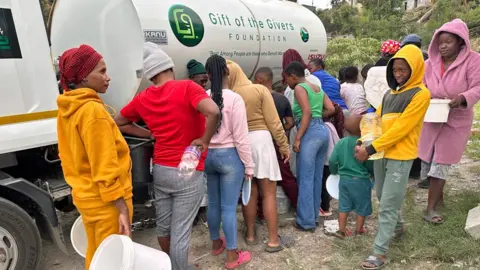
Non-governmental organizations like Gift of the Givers have also stepped in to throw a lifeline to residents who cannot afford back-up measures.
They bring thousands of litres of water in tankers almost daily to the town. There is serious gratitude from the people when we arrive, Gift of the Givers' local co-ordinator Mario Ferreira told the BBC. The disturbing thing is [that] the people start thinking this is the way of life and it shouldn't be, Ferreira added.
Water is rationed to 50 litres per person per day - to put that into perspective, the average person in the UK uses 142 litres a day, according to Water UK. There are fears queuing for water rations will become a reality unless a solution is found.
Mayor Thando Matika acknowledges the problems, but is quick to point out that he inherited them from his predecessors. The municipality has for years not been doing maintenance. They said there was no money. Even the boreholes dug in 2009 were not working anymore, he told the BBC.
His council has now received an emergency cash boost from the national government of $1.25 million to deal with the crisis. Plans include fixing the town's seven boreholes and desalination plant as well as drilling for an extra borehole in the short term.
Looking at how to recycle water and building another dam are part of its longer-term focus. Hydrologists are in town looking at that process, the mayor explained.
Water meters will also be installed in homes where there are none or they have been broken. Restrictions were put in place in January, including reducing the town's water pressure, and people are banned from watering gardens, filling pools, and washing boats with municipal water.
Experts like Dr. Ferial Adam of campaign group Watercan warn that complacency must not set in. South Africa needs urgent action to ensure water security, especially as millions live with water scarcity daily.