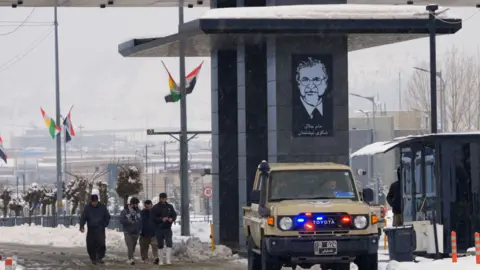
At the border crossing from Iran into Iraqi Kurdistan, the stern face of Iran's former supreme leader, Ayatollah Khomeini, peers down at the trickle of Iranians leaving the territory.
Thick snowflakes confetti the lorries and pedestrians arriving at this remote mountain pass.
Metres away, just beyond the border post, an Iranian flag flutters in the snow.
Iran has shut down the internet and blocked phone calls into the country, but its borders are still open.
Inside the arrivals hall, we find dozens of men, women and children – many arriving to visit family on the Iraqi side of the border.
No-one we met said they were fleeing Iran because of the recent protests and government crackdown, but one man – who asked us to hide his identity – told us security forces had shot him during a protest in central Iran last Friday.
I was hit in the face by seven pellet rounds, he said, pointing out several weals and bruises on his face. They struck above my eyelid, on my forehead, my cheek, my lip, under my ear and along my jaw. I had to use a razor blade to cut one of the pellets out.
He told us he was too afraid of being arrested to get medical help, and that others injured during the government crackdown on protestors were also avoiding treatment, out of fear that security forces would arrive and arrest them.
One of my friends told me he was hit by a pellet round, he told us. His son, who is around 12 or 13 years old, was struck twice in the leg by live ammunition. One of the bullets is lodged in the shin bone. They're terrified of going to hospital to have it removed.
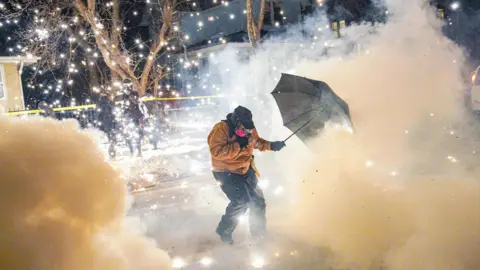
Iran's regime has treated these protests as an existential threat. Its crackdown seems to be working, with protesters largely staying at home, fearing for their safety amidst the violence. Rights groups estimate that around 2,500 individuals have been killed in the unrest.
However, reports suggest that demonstrations have continued, at least into this week. The protester we spoke to stated that security forces had suppressed protests in his town last Friday but acknowledged that unrest persisted in other locations.
Iranians don't require a visa for crossing here, and officials indicate regular traffic moving in both directions.
Another man we interviewed had witnessed protests on the streets of Tehran just a few days prior, although the verification of such events remains complicated due to media restrictions in Iran.
The government's methods of repression appear to be effective, yet the underlying economic issues driving this crisis continue unresolved, with citizens expressing a desire for improved living conditions amid growing dissatisfaction.