In brief
The extraordinary discovery of "Yana," a 50,000-year-old baby mammoth found in Siberia, showcases the effects of climate change on ancient remains. This nearly intact carcass is the best-preserved of its kind, promising valuable information about prehistoric ecosystems.
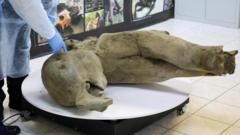
Russian scientists recently announced a groundbreaking discovery: the remains of a 50,000-year-old baby mammoth, affectionately named "Yana" after the river basin where she was unearthed. Found in thawing permafrost in Yakutia during the summer, this mammoth promises to be a vital link to understanding prehistoric life, having been preserved in astonishing detail due to Siberia's bitter cold. Yana weighs over 100 kilograms (approximately 15 stone 10 pounds) and measures about 120 centimeters (4 feet) in height and 200 centimeters in length. Researchers believe that she was roughly one year old at the time of her death. Prior to this discovery, the world had only six similar findings, five from Russia and one from Canada, making Yana an exceptional find in the field of paleontology.The baby mammoth was located within the Batagaika crater, the largest permafrost crater globally. Residents in the area stumbled upon Yana during their daily activities, noticing that the mammoth was nearly fully thawed. The head of the Lazarev Mammoth Museum Laboratory, Maxim Cherpasov, explained how the locals ingeniously constructed a makeshift stretcher to bring Yana to the surface, emphasizing that parts usually decay or are consumed by modern predators.Gavril Novgorodov, a researcher at the museum, suggested that Yana may have been trapped in a swamp-like environment, contributing to her remarkable preservation over thousands of years. Currently, she is being analyzed at the North-Eastern Federal University in Yakutsk, where scientists are conducting tests to ascertain the exact time of her death.This mammoth discovery follows a trend of remarkable prehistoric findings in Russian permafrost, which is becoming increasingly accessible as climate change accelerates thawing. Last month, scientists showcased the partial remains of a 32,000-year-old sabre-tooth cat, and earlier this year, the remains of a 44,000-year-old wolf were also revealed. Each of these discoveries deepens our understanding of ancient ecosystems and the animals that once roamed them.