In brief
Recent archaeological findings at Brusselstown Ring in the Wicklow Mountains indicate that a sizable settlement existed as early as 1200 BC, predating the Vikings. Dr. Dirk Brandherm and his team have identified the site as the largest known nucleated settlement in prehistoric Britain and Ireland. The discovery of a possible cistern raises questions about urban life during the Late Bronze Age in Ireland, suggesting complex social structures earlier than previously thought.
A recently discovered large hilltop settlement could challenge the theory that the Vikings built the first towns in Ireland, a researcher has said.
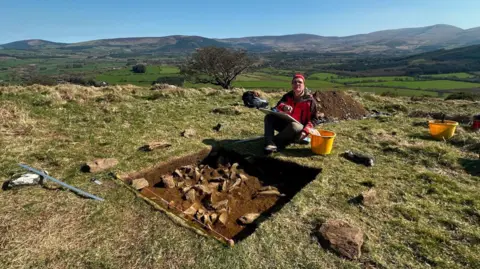
Dr. Dirk Brandherm and his colleagues have identified more than 600 suspected houses in the Brusselstown Ring, making it, to date, the largest nucleated settlement ever discovered in the entirety of prehistoric Britain and Ireland.
The settlement, which is thought to have emerged at about 1200 BC (the Late Bronze Age), is located within a region called the Baltinglass Hillfort Cluster in the south-western edge of the Wicklow Mountains.
It is among the 13 large hilltop enclosures spread across the mountain range where there are structures dating back to the Neolithic period and Early Bronze Age.
The findings were recently published in Antiquity, a peer-reviewed journal of world archaeology.
Dr. Brandherm emphasized the significance of the Brusselstown Ring due to its high concentration of roundhouses, suggesting that this discovery reshapes the historical narrative about the establishment of towns in Ireland attributed to Viking influence.
He explained, Because if you've got more than 600 roundhouses, and potentially a large stone-built cistern, that's no longer a village; we're talking a proto-town of sorts, and that's 2000 years before the Vikings.
The excavation also unearthed a stone-lined chamber that may have served as a water cistern, marking a potential first in Irish archaeology.
As research continues, the implications of this discovery could redefine our understanding of social structure and urbanization during Ireland's prehistoric era.