In brief
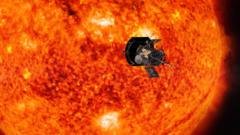
NASA's Parker Solar Probe has achieved a remarkable milestone by surviving its closest-ever approach to the Sun, sending back signals to Earth following an intense flyby. The spacecraft passed just 3.8 million miles (6.1 million km) from the solar surface while reaching speeds of up to 430,000 mph (692,000 kph) and withstanding extreme temperatures as high as 1,800°F (980°C). This pioneering mission, launched in 2018, aims to unlock mysteries about the Sun’s outer atmosphere, known as the corona, and the solar wind—an ongoing flow of charged particles influencing Earth’s magnetic field.
On Christmas Eve, the Parker Solar Probe ventured deep into the Sun’s corona, sparking excitement and anticipation among scientists. The probe’s advanced thermal protection system shielded it from the harsh conditions, allowing researchers to gather invaluable data to enhance insights into solar phenomena. According to Dr. Nicola Fox from NASA, experiencing the atmosphere of the Sun firsthand is crucial for a deeper understanding of its properties and behaviors. Scientists are particularly interested in why the corona, despite being farther from the Solar surface, reaches temperatures in the millions. Understanding these extreme temperatures is integral for explaining how the solar wind impacts Earth, particularly given its effects on our technology and space weather phenomena such as auroras. The mission promises to address key questions about solar dynamics that have baffled researchers for years, reiterating its significance for both science and everyday life on Earth.As data continues to pour in from the Parker Solar Probe, scientists are hopeful that the mission will ultimately lead to breakthroughs regarding the mysteries of the Sun and its behavior, shaping our understanding of space weather and its implications on Earth.