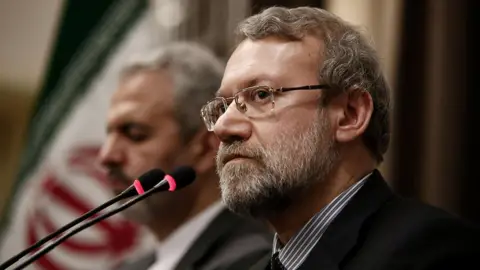
The death of Ali Larijani, Iran's influential security chief, has significantly deepened the crisis at the heart of Iran's leadership. Killed in an Israeli airstrike, Larijani was not a military commander but played a crucial role in shaping Iran's strategic decisions and national security policy.
As the secretary of the Supreme National Security Council, he was instrumental in high-stakes decision-making regarding war, diplomacy, and Iran's stance against the United States and Israel. Following the assassination of Supreme Leader Ali Khamenei on February 28, Larijani's defiant rhetoric indicated Iran's readiness for an extended conflict.
His death, now confirmed by state media, is part of a troubling trend, with several high-ranking Iranian officials and commanders removed in rapid succession. This pattern appears to serve a broader strategic goal of destabilizing Iran's leadership during a critical wartime period.
Typically characterized as a hardliner but also regarded as a pragmatic figure, Larijani favored calculated strategies over mere rhetoric. Although skeptical about Western engagement, he contributed to significant diplomatic efforts, including the long-term cooperation agreement with China.
At the time of his death, Larijani was managing three notable crises: the ongoing war, an immediate wave of domestic unrest fueled by economic grievances, and stalled negotiations concerning Iran's nuclear program. His abrupt removal leaves these pressing matters unresolved for an as-yet-unknown successor, who will inherit a fragile and complex situation.
The implications of Larijani's death extend beyond his individual contribution, as it highlights the ongoing leadership crisis affecting both Iran's wartime strategy and domestic stability. In the face of his absence, the Iranian leadership's future adaptability and resilience remain uncertain amidst continued military threats and increasing internal dissent.
As the secretary of the Supreme National Security Council, he was instrumental in high-stakes decision-making regarding war, diplomacy, and Iran's stance against the United States and Israel. Following the assassination of Supreme Leader Ali Khamenei on February 28, Larijani's defiant rhetoric indicated Iran's readiness for an extended conflict.
His death, now confirmed by state media, is part of a troubling trend, with several high-ranking Iranian officials and commanders removed in rapid succession. This pattern appears to serve a broader strategic goal of destabilizing Iran's leadership during a critical wartime period.
Typically characterized as a hardliner but also regarded as a pragmatic figure, Larijani favored calculated strategies over mere rhetoric. Although skeptical about Western engagement, he contributed to significant diplomatic efforts, including the long-term cooperation agreement with China.
At the time of his death, Larijani was managing three notable crises: the ongoing war, an immediate wave of domestic unrest fueled by economic grievances, and stalled negotiations concerning Iran's nuclear program. His abrupt removal leaves these pressing matters unresolved for an as-yet-unknown successor, who will inherit a fragile and complex situation.
The implications of Larijani's death extend beyond his individual contribution, as it highlights the ongoing leadership crisis affecting both Iran's wartime strategy and domestic stability. In the face of his absence, the Iranian leadership's future adaptability and resilience remain uncertain amidst continued military threats and increasing internal dissent.