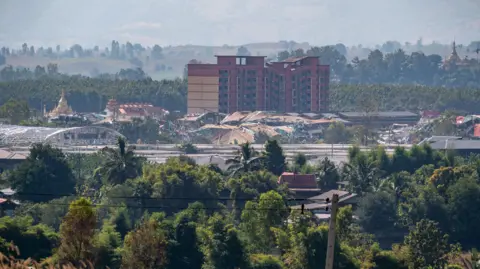
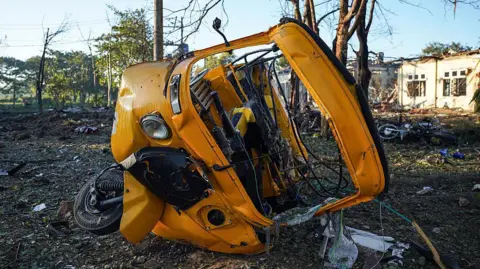
The recent earthquake that struck Myanmar has resulted in a significant increase in casualties, with the death toll now approaching 700 and over 1,600 injured, as reported by the military government. The 7.7-magnitude quake occurred on Friday afternoon near Mandalay, one of Myanmar's largest cities, leading to widespread devastation across the region.
Following the disaster, Myanmar's junta issued an unusual plea for international assistance. The earthquake's epicenter was close to the Sagaing Fault, a highly active seismic zone, causing severe structural damage, particularly in Mandalay. The tremors were felt across Southeast Asia, reaching as far as Bangladesh, Vietnam, and southern China.
As rescue operations commence, local hospitals are overwhelmed with victims. The U.S. Geological Survey has modeled potential outcomes, indicating that the death toll could surpass 1,000, with forecasts reaching as high as 10,000. The densely populated areas adjacent to the epicenter raise the likelihood of significant casualties.
Myanmar's history of civil unrest and military rule poses considerable challenges for humanitarian efforts. Logistical barriers are likely to complicate the delivery of aid, and the junta's tight control over internet access could hinder information flow and updates on the recovery process. The international community faces hurdles in ensuring that essential resources reach those in need amidst an ongoing conflict environment.
The quake has already prompted aid responses from neighboring countries; China is dispatching rescue teams to assist the affected areas. As the situation develops, the focus remains on providing relief to the countless individuals impacted by this disaster.
Rescue efforts continue as more information about the full extent of the havoc remains unclear, hampered by restricted communications and proximity to conflict zones.
Following the disaster, Myanmar's junta issued an unusual plea for international assistance. The earthquake's epicenter was close to the Sagaing Fault, a highly active seismic zone, causing severe structural damage, particularly in Mandalay. The tremors were felt across Southeast Asia, reaching as far as Bangladesh, Vietnam, and southern China.
As rescue operations commence, local hospitals are overwhelmed with victims. The U.S. Geological Survey has modeled potential outcomes, indicating that the death toll could surpass 1,000, with forecasts reaching as high as 10,000. The densely populated areas adjacent to the epicenter raise the likelihood of significant casualties.
Myanmar's history of civil unrest and military rule poses considerable challenges for humanitarian efforts. Logistical barriers are likely to complicate the delivery of aid, and the junta's tight control over internet access could hinder information flow and updates on the recovery process. The international community faces hurdles in ensuring that essential resources reach those in need amidst an ongoing conflict environment.
The quake has already prompted aid responses from neighboring countries; China is dispatching rescue teams to assist the affected areas. As the situation develops, the focus remains on providing relief to the countless individuals impacted by this disaster.
Rescue efforts continue as more information about the full extent of the havoc remains unclear, hampered by restricted communications and proximity to conflict zones.