In brief
Ties between U.S. President Donald Trump and Indian Prime Minister Narendra Modi have soured dramatically after Trump introduced a 50% tariff on Indian goods, accusing India of supporting Russia's war in Ukraine. This move disrupts a previously strong partnership, complicating trade negotiations amid conflicting geopolitical pressures and Modi's attempts to safeguard domestic interests.
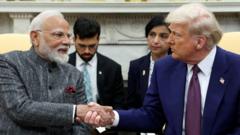
Despite efforts at diplomacy, the relationship has hit a new low as India seeks to balance energy security with national pride amid increasing U.S. demands. Relations between U.S. President Donald Trump and Indian Prime Minister Narendra Modi have reached a new low, with tensions escalating following Trump's imposition of a hefty 50% tariff on Indian goods. The tariff was introduced as a reaction to what Trump has described as India's role in funding Russia's ongoing conflict in Ukraine via its oil purchases. Once characterized by mutual admiration and ambitious trade goals, the partnership now appears precarious only months after it flourished. In the initial months of Trump's second term, he warmly embraced Modi, labeling him a "great friend" and promising to enhance bilateral trade to $500 billion by 2030. However, the introduction of tariffs — comprising an initial 25% plus an additional 25% — has sparked outrage in New Delhi. Government officials quickly condemned the tariffs as "unfair, unjustified, and unreasonable," stating that the measures disregard the complexities of global energy markets and India's pressing need for cost-effective energy solutions. Despite maintaining a restrained public stance in hopes of resuming productive diplomacy, Modi's administration is confronted with a delicate situation that warrants a firm response against external pressure. Trump's recent statements criticizing India's economy further exacerbate the tensions, leaving Delhi caught between the desire for trade cooperation and a growing sense of national pride. The challenges have been intensified by the U.S. administration's decision to enhance ties with Pakistan, including favorable trade deals which have ruffled feathers in India. Compounding matters, Trump has made claims concerning mediation in the India-Pakistan conflict, contradicting India's long-held position that such disputes are strictly internal. Political analysts indicate that Trump's actions could signal a negotiating tactic; by applying pressure, he may seek concessions from Modi that benefit U.S. interests. However, any attempt at compromising agricultural and dairy sectors — deemed by Delhi as red lines due to their economic significance — remains a contentious point. India, despite navigating the diplomatic tightrope of energy needs and international relations, continues to procure significant oil supplies from Russia, leveraging low prices as a strategy for citizen welfare. The Indian public and Modi's administration view Russia as a historical ally, distinguishing between geopolitical rhetoric and practical economic partnerships. On the broader spectrum, both nations still share strategic links, particularly in technology and defense. However, the unpredictable nature of Trump’s administration raises uncertainty about the future of these relationships. While the foundations of the U.S.-India partnership remain intact, the current political climate suggests that rebuilding trust and diplomacy may take considerable time and effort. In summary, the evolving complexities of U.S.-India relations demand astute navigation from both sides, with the potential to either repair the damage or further exacerbate geopolitical rifts in the region.