
In brief
Major Asian stock markets saw dramatic falls as tariffs impose stress on the region's economies, resulting in heightened concerns over a potential recession in the US.
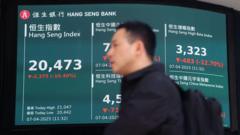
Asian stock markets recoiled sharply on Monday, reflecting the turmoil generated by recent tariff hikes imposed by US President Donald Trump. Major indices across Asia experienced significant declines, with markets from Shanghai to Tokyo witnessing a collective downturn following the announcement of new tariffs affecting a wide range of goods.As trading opened, Japan's Nikkei 225 index plummeted over 6%, while Australia's ASX 200 and South Korea's Kospi saw decreases of 4% and 4.7%, respectively. Investors in mainland China, Hong Kong, and Taiwan were particularly rattled, experiencing some of the largest drops. For instance, the Shanghai Composite fell more than 6%, and both the Hang Seng and Taiwan Weighted Index spiraled downwards by around 10%. "It’s a bloodbath," noted an analyst, commenting on the severity of the market reaction.The cascading effects of the tariffs are particularly pronounced in Asia, a region that heavily relies on manufacturing and exports to the United States, which has compounded existing fears about a global trade war leading to economic recession. Julia Lee, Head of FTSE Russell, emphasized that heightened tariffs are stoking concerns around inflation and economic stagnation.Goldman Sachs has raised its recession forecast for the US to 45% in the next year, up from 35%, while JPMorgan posits a 60% chance for both US and global recessions. The ramifications of a potential downturn in the US economy are significant, as it is a critical market for Asian exports.Countries such as Vietnam and Bangladesh are particularly susceptible, given their heavy dependence on the US as an export destination. Trump's recent tariff measures, which include hefty tariffs of 46% on Vietnam and 37% on Bangladesh, could substantially impact these economies. For instance, Vietnam is home to several major US brands, while Bangladesh exports approximately $8.4 billion worth of garments annually to the US.Former US trade undersecretary Frank Lavin articulated that the export-oriented nature of these Asian economies makes them more vulnerable to US market fluctuations. Furthermore, after retaliatory tariffs from China, the global stock market experienced heightened instability, leading to significant losses in value on both US and European exchanges.The chaotic market conditions signal a continuing trend of volatility as US futures point towards further declines, suggesting another tough trading session ahead. As tariff repercussions ripple through the global economy, analysts predict ongoing challenges for both Asia and international markets alike.



