
In brief
In a moving account, Nasser Faratawi shares the traumatic experience of seeing his family home in Tulkarm taken over by the Israeli Defense Forces for military operations. After enduring months of turmoil and eventual destruction, he is left to assess the damage, lamenting the loss of his business and possessions. The ongoing conflict continues to strain Palestinian lives amid increasing military actions in the West Bank.
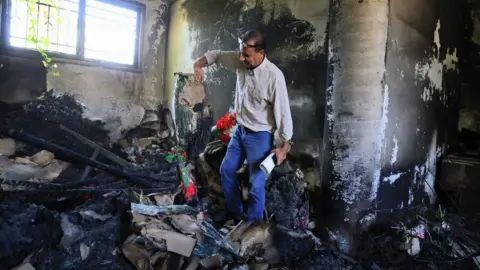
Nasser Faratawi holds up a blackened garland of silicone flowers and a singed Ramadan lantern as he picks through the charred ruins of what was his popular party shop in Tulkarm in the north of the occupied West Bank.
Upstairs, on the three floors of what were his family's luxury apartments, graffiti is scrawled on the walls – including drawings of penises in a living room and his daughter's bedroom.
Expensive furniture has been broken or thrown out of the window, fancy decorations ripped out, every page of a Quran torn, and it stinks of rotten leftover food.
They came and destroyed me, Nasser tells me. It's all seen as destroyable because I live in this city - because I am Palestinian.
On 3 March, the Israeli military arrived at the Faratawi property and gave the family an hour and a half to leave. The Israel Defense Forces (IDF) took over the building while they carried out a huge operation nearby, in Tulkarm refugee camp.
They took it as an army base and they lived in it for three-and-a-half months, using it like a hotel, and then they set it on fire, Nasser says, still in disbelief at what happened.
Watching from a distance, he says he saw on 11 June that a fire had been started in his warehouse and shop – where locals used to bring their cars to be decorated for weddings.
It was very hard for me to see my business burning. Everything I had worked for, for over 30 years, Nasser says. His neighbourhood remained a closed military zone, and he was only allowed to return at the start of this month.
Asked about the state of the property, the Israeli military told the BBC that it was not aware of any arson committed by its troops at the site, and that a complaint about the incident has been submitted and is under review.
Since the deadly Hamas-led attacks on Israel on 7 October 2023 triggered the brutal war in the Gaza Strip, world attention has largely been focused there. But tensions have also rocketed in the West Bank, with increased Israeli settler attacks and military operations which Israel says are aimed at Palestinian militants.
The UN says more than 900 Palestinians have been killed in the West Bank by IDF action and settlers in that period. At the same time, more than 60 Israelis have been killed in reported attacks by Palestinians or in armed clashes in the West Bank and Israel.
While Nasser Faratawi is back in his home, he wonders how he will ever renovate it. He estimates that his total losses are up to $700,000 (£520,000; €600,000). He can complain to Israeli authorities, but past evidence suggests it is highly unlikely he will get any compensation.
Without his shop and with his stock destroyed, Nasser has no income and worries that he can no longer support his son and daughter, who have been studying medicine in Egypt. He is appealing for help from international organisations.
I'm an ordinary person, a businessman, he says. I love peace. I never before had a weapon in my house. I had no problem with the Israeli army. I want peace and to live in peace, but they don't want peace.


