In brief
India's unique position in international relations is becoming increasingly complicated. With a balancing act between the United States, China, and Russia, India's foreign policy is at a crossroads. Recent criticisms from the U.S. regarding its relations with Russia, coupled with a meeting between Modi and Xi, highlight the complexities of India's strategic positioning. Analysts suggest that India aims for strategic autonomy while navigating the fraying multipolarity in global politics.
This is a time for us to engage America, manage China, cultivate Europe, reassure Russia, bring Japan into play, draw neighbours in, extend the neighbourhood and expand traditional constituencies of support, Indian Foreign Minister S Jaishankar wrote in his 2020 book The India Way: Strategies for an Uncertain World.
For over a decade, India has styled itself as a key node in a new multipolar order: one foot in Washington, another in Moscow, and a wary eye on Beijing.
But the scaffolding is buckling. Donald Trump's America has turned from cheerleader to critic, accusing India of bankrolling Moscow's war chest with discounted oil purchases. Delhi now faces the sting of Trump's public rebuke and higher tariffs.
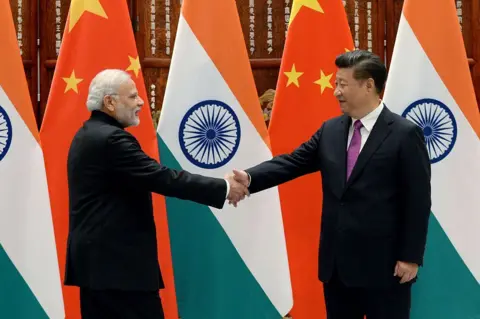
With multipolarity fraying, many say Prime Minister Narendra Modi's planned meeting with Xi Jinping in Beijing appears less like triumphal diplomacy and more like pragmatic rapprochement.
Yet, Delhi's foreign policy stands at an uneasy crossroads.
India finds itself in two camps: a pillar of Washington's Indo-Pacific Quad and a member of the Shanghai Cooperation Organisation (SCO), the China and Russia-led bloc. Delhi's dual status complicates its diplomatic efforts as it continues to court U.S. investment while purchasing discounted Russian oil.
Analysts emphasize that this balancing act reflects India's emphasis on strategic autonomy, believing that engaging with competing powers provides leverage rather than vulnerability.
As the U.S.-China rivalry deepens, India must navigate dangerous waters, balancing its relationship with Washington while managing ties with its traditional ally, Russia, and keeping a wary distance from an increasingly assertive China.
The ongoing strategic dialogues within and around India, China, and Russia paint a picture of a country striving to maintain its independence amid a world of shifting alliances. It is within this complex dynamic that India's true diplomatic challenge lies.