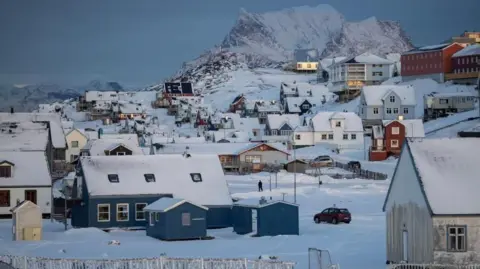
A bipartisan group of members of the US Congress is visiting Denmark in what is seen as a show of support in the face of increasing pressure from President Donald Trump for the US to annex Greenland - a semi-autonomous region of Denmark in the Arctic.
The 11-member delegation is due to meet MPs as well as Danish Prime Minister Mette Frederiksen and her Greenlandic counterpart Jens-Frederik Nielsen.
The visit comes days after high-level talks in Washington failed to dissuade Trump from his plans.
He insists Greenland is vital for US security - and that Denmark cannot defend it against possible Russian or Chinese attacks. Both Denmark and Greenland say they are opposed to a US takeover.
Greenland is sparsely-populated but resource-rich and its location between North America and the Arctic makes it well placed for early warning systems in the event of missile attacks and for monitoring vessels in the region.
The US already has more than 100 military personnel permanently stationed at its Pituffik base - a facility that has been operated by the US since World War Two.
Under existing agreements with Denmark, the US has the power to bring as many troops as it wants to Greenland.
But Trump has said the US needs to 'own' it to defend it properly. He has consistently offered to buy it off - an offer rejected by Denmark and Greenland - whilst mooting the possibility of seizing it by force.
Denmark has warned that military action would spell the end of NATO - the trans-Atlantic defence alliance where the US is the most influential partner.
NATO works on the principle that allies have to aid each other in case of attack from outside - it has never faced an option where one member would use force against another.
European allies have rallied to Denmark's support, emphasizing that the Arctic region's security should be a joint responsibility, with the US involved.
To this end, several countries including France, Germany, Sweden, Norway, Finland, the Netherlands and the UK have sent a limited number of troops to Greenland in a reconnaissance mission.
French President Emmanuel Macron stated that 'land, air, and sea assets' would soon be sent.
Despite the contentious backdrop, the bipartisan US delegation is united in its support for NATO, and Senator Coons has emphasized collaboration with allies. Democratic and Republican lawmakers have remarked on the need to prevent any unilateral action from the US regarding Greenland.
Amidst this political turmoil, Trump's envoy to Greenland insists discussions should primarily involve Greenland's leaders rather than Denmark, suggesting potential negotiations to find a solution in the matter.