In brief
President Trump has urged for a major investment of at least $100 billion in Venezuela's oil industry, facing skepticism from executives who deem the country 'uninvestable.' Despite acknowledging Venezuela's vast energy reserves, industry leaders emphasize the necessity for significant changes to attract investment. The proposal comes after heightened U.S. military involvement following the capture of Nicolás Maduro, leading to a complex dynamic in U.S.-Venezuela relations over oil production.
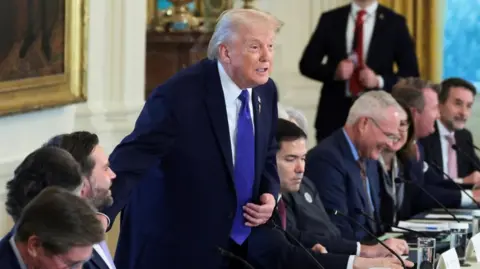
US President Donald Trump has asked for at least $100bn (£75bn) in oil industry spending for Venezuela, but received a lukewarm response at the White House as one executive warned the South American country was currently 'un-investable.'
Bosses of the biggest US oil firms who attended the meeting acknowledged that Venezuela, sitting on vast energy reserves, represented an enticing opportunity. However, they stated that significant changes would be needed to make Venezuela an attractive investment. No major financial commitments were immediately forthcoming.
Trump has said he will unleash the South American nation's oil after US forces seized its leader Nicolas Maduro in a 3 January raid on its capital.
One of the things the United States gets out of this will be even lower energy prices, Trump noted in the meeting.
Despite Trump's promises, oil executives expressed caution. Exxon's CEO, Darren Woods, pointed out their previous experiences with asset seizures in Venezuela, reinforcing the necessity for substantial changes for any serious re-entry into the market. Today it's uninvestable, Woods remarked.
Venezuela's relationship with international oil firms has been complicated over the past century. Currently, Chevron is the only major American oil firm operating there, while others like Spain’s Repsol and Italy’s Eni remain active.
Trump emphasized that his administration would control which firms could operate, stating, You're dealing with us directly. You're not dealing with Venezuela at all. We don't want you to deal with Venezuela. This statement points to the ongoing tensions and U.S. attempts to exert influence over the Venezuelan government.
The White House is reportedly working on selectively rolling back U.S. sanctions that have hampered Venezuelan oil sales. They've been cooperating with interim authorities in Venezuela, while ensuring they retain some control over oil sales as leverage against the current regime.
Venezuela's oil production has suffered due to a mix of disinvestment, poor management, and U.S. sanctions. Currently producing about one million barrels per day, Venezuela represents less than 1% of global oil supply. While companies like Chevron expect to bolster their production, the broader oil industry remains skeptical about making significant investments absent political stability and certainty.
Analysts express doubt that commitments will materialize before the political situation stabilizes. The conditions are just not right, said David Goldwyn, a former U.S. State Department energy envoy. Any meaningful increase in production, they argue, may take several years and depend on new, robust investments and improved political circumstances.