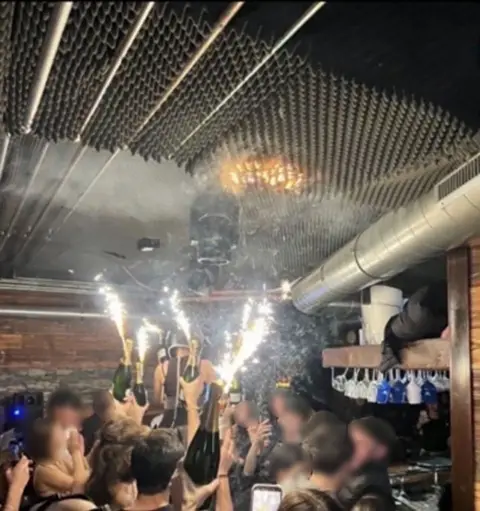
Investigators are racing to establish how and why the deadly New Year's Eve fire at a bar in a Swiss ski resort spread so rapidly. Authorities on Friday stated that sparklers attached to champagne bottles held too close to the ceiling appear to have ignited the blaze in the basement of Le Constellation bar in Crans-Montana. The fire claimed the lives of at least 40 individuals and left 119 injured, many severely. Authorities have turned their attention to the bar’s safety protocols as the investigation continues.
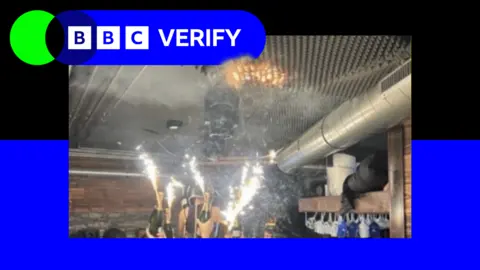
Videos taken by survivors show alarming footage of people celebrating with brightly lit sparklers above their heads, posing a significant fire hazard. One particular image shows flames beginning to gather on the ceiling above attendees holding sparklers, while another captures a person wearing a crash helmet further endangering themselves by holding sparklers even closer to the ceiling.
Critics are questioning the materials used for the bar’s foam ceiling, which resembles polyurethane foam, known for its acoustic properties and potential flammability if untreated. Fire safety experts suggest that such materials can fuel rapid flame spread and produce toxic smoke, thereby complicating escape efforts during a fire.
As investigators assess past safety inspections and protocols for escape routes, there are concerns about the effectiveness and compliance of the exit strategies in place during the tragic events of New Year's Eve. Notably, videos of the chaotic scene depict patrons struggling to evacuate up narrow staircases as the fire consumed the space, emphasizing the need for better safety measures in crowded venues.
The combination of hazardous celebratory practices, potential safety violations, and inadequate escape routes raises critical questions about fire safety standards in public spaces, especially during high-capacity events.
Videos taken by survivors show alarming footage of people celebrating with brightly lit sparklers above their heads, posing a significant fire hazard. One particular image shows flames beginning to gather on the ceiling above attendees holding sparklers, while another captures a person wearing a crash helmet further endangering themselves by holding sparklers even closer to the ceiling.
Critics are questioning the materials used for the bar’s foam ceiling, which resembles polyurethane foam, known for its acoustic properties and potential flammability if untreated. Fire safety experts suggest that such materials can fuel rapid flame spread and produce toxic smoke, thereby complicating escape efforts during a fire.
As investigators assess past safety inspections and protocols for escape routes, there are concerns about the effectiveness and compliance of the exit strategies in place during the tragic events of New Year's Eve. Notably, videos of the chaotic scene depict patrons struggling to evacuate up narrow staircases as the fire consumed the space, emphasizing the need for better safety measures in crowded venues.
The combination of hazardous celebratory practices, potential safety violations, and inadequate escape routes raises critical questions about fire safety standards in public spaces, especially during high-capacity events.