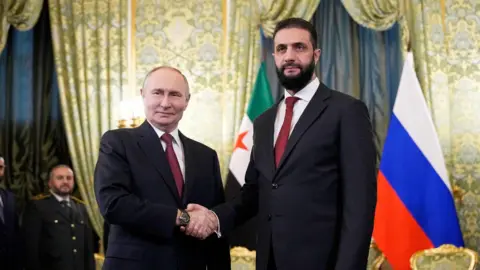
Syria's interim President, Ahmed al-Sharaa, has held his first talks with President Vladimir Putin in Moscow since ousting Russia's ally Bashar al-Assad 10 months ago. Putin spoke of the 'special relationship' between both countries. Sharaa suggested he would continue to allow Russia access to its military bases in Syria. He was also expected to ask for the extradition of Assad, who was granted asylum after fleeing to Moscow.
For years they were enemies, on opposing sides of a bloody civil war. Putin used brutal military force to prop up Bashar al-Assad. And Sharaa's armed Islamist group led the rebel offensive that eventually forced Assad from power.
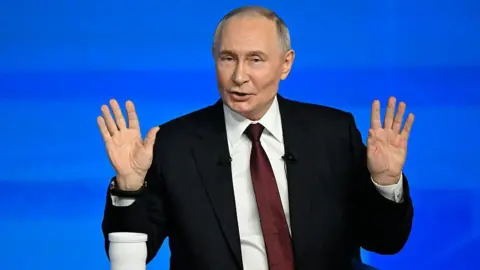
But on Wednesday, the Russian and Syrian leaders sat down together for the first time, putting pragmatism ahead of past enmity. 'Over the past decades, our countries have built a special relationship,' Putin said. He added that there were 'quite a few interesting and useful undertakings' on the agenda of their talks, and that Russia stood ready to 'do everything to fulfil them.'
Sharaa expressed a desire for Syria to re-establish relations with all countries, with a particular focus on Russia, aiming for 'independence' and territorial integrity for Syria. The two leaders shared warm sentiments, signaling a potential shift toward a productive partnership.
Russia seeks to maintain access to its Tartous naval port and Hmeimim military airbase along Syria's Mediterranean coast, which Sharaa indicated would be respected. In return, Sharaa hopes for assistance in consolidating his power, securing borders, and revitalizing Syria's struggling economy through Russian investments and energy resources. Russian ministers are prepared to provide essential supplies like food and medication and assist in rebuilding infrastructure.
However, underlying tensions persist. Reports suggest Sharaa will request Assad's extradition for war crimes, a request unlikely to be met favorably by Russia, which granted Assad asylum due to risks to his life. Foreign Minister Sergei Lavrov emphasized the protection of Assad and his family, underscoring the complexities of this new geopolitical landscape.
For years they were enemies, on opposing sides of a bloody civil war. Putin used brutal military force to prop up Bashar al-Assad. And Sharaa's armed Islamist group led the rebel offensive that eventually forced Assad from power.
But on Wednesday, the Russian and Syrian leaders sat down together for the first time, putting pragmatism ahead of past enmity. 'Over the past decades, our countries have built a special relationship,' Putin said. He added that there were 'quite a few interesting and useful undertakings' on the agenda of their talks, and that Russia stood ready to 'do everything to fulfil them.'
Sharaa expressed a desire for Syria to re-establish relations with all countries, with a particular focus on Russia, aiming for 'independence' and territorial integrity for Syria. The two leaders shared warm sentiments, signaling a potential shift toward a productive partnership.
Russia seeks to maintain access to its Tartous naval port and Hmeimim military airbase along Syria's Mediterranean coast, which Sharaa indicated would be respected. In return, Sharaa hopes for assistance in consolidating his power, securing borders, and revitalizing Syria's struggling economy through Russian investments and energy resources. Russian ministers are prepared to provide essential supplies like food and medication and assist in rebuilding infrastructure.
However, underlying tensions persist. Reports suggest Sharaa will request Assad's extradition for war crimes, a request unlikely to be met favorably by Russia, which granted Assad asylum due to risks to his life. Foreign Minister Sergei Lavrov emphasized the protection of Assad and his family, underscoring the complexities of this new geopolitical landscape.