
In brief
Ghana is aiming to increase the processing of its cashews, a key export, amid challenges in the industry. Farmers face volatile prices and unreliable supply chains, with most cashews exported in raw form to countries like India and Vietnam for processing. Local entrepreneurs, meanwhile, urge the government for support and improved market access.
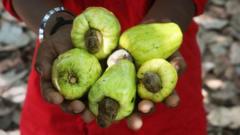
Ghana is striving to elevate the value of its cashew nut industry, despite facing significant hurdles. As the world's third-largest exporter of unprocessed cashew nuts—following Ivory Coast and Cambodia—the nation stands on the brink of a potential agricultural breakthrough, yet struggles to reap substantial financial rewards from its prized crop. A visit to a bustling stall in Accra unfolded a stark reality: a mere 30g packet of roasted cashews priced at approximately 75 cents highlights a staggering markup when compared to the raw, unshelled nuts sold by local farmers. "This is incredible," I remarked, bewildered by the sleek pricing that remains elusive to many locals.Approximately 300,000 Ghanaians depend on cashew farming for their livelihoods, battling the pressures of inconsistent supply chains and volatile market pricing. Local farmer Nashiru Seydou expressed the uphill battle he faces, stating, “We are struggling. The government needs to invest in our industry to help create jobs.” His farm sells a large sack of unshelled cashews for around $50, while the same product can fetch up to $500 per tonne at wholesale prices. Despite producing 180,000 tonnes of cashews annually, over 80% remain unprocessed—amounting to $300 million in export revenue. The potential profits from roasting and marketing these nuts are untapped, with a prominent entrepreneur, Mildred Akotia from Akwaaba Fine Foods, indicating that only 25 tonnes are processed yearly. She cites high interest rates from local banks, at around 30%, as a barrier to expanding her business operations.The situation leads to an odd occurrence—raw Ghanaian cashews are exported, processed abroad, and sold back in Ghana for similar prices, despite extensive transportation costs. Past government actions, such as a hastily abandoned export ban on raw nuts in 2016, show how complex the pathways to encouraging local processing are.Bright Simons, an economic commentator, insists local producers must focus on scaling their operations while building demand for cashews domestically. Scholars, including Nobel laureate Daron Acemoglu, stress improving access to international markets as a key priority for flourishing local businesses burdened by infrastructural issues and regulatory uncertainties.Mildred Akotia is determined to shift this narrative, aiming to streamline logistics from farm to consumer while expanding production capabilities. “We have a strong demand from the UAE, Canada, and the US, yet our supply struggles to keep pace,” she emphasized, laying out her vision for Ghana’s processed foods sector.In a landscape where Ghana’s other exports often leave the country with little added value—like gold and chocolate—the cashew nut industry has the potential for significant transformation, provided that both local businesses and governmental strategies can align for success. With aspirations of becoming leaders in cashew processing, Ghanaians remain hopeful for a sustainable and prosperous agricultural future.


