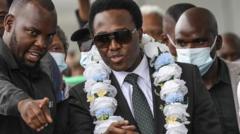
Mozambique's main opposition leader, Venâncio Mondlane, has expressed a willingness to collaborate with President Daniel Chapo's government, contingent upon several key demands aimed at resolving ongoing political tensions following contentious elections. In interviews with the BBC, both leaders conveyed a readiness for dialogue amidst the backdrop of unrest that has resulted in approximately 300 fatalities. Mondlane, who ran for the presidency for the first time in October, remains resolute in denying his electoral defeat, characterizing the process as fraudulent. Official results declared Chapo of the ruling Frelimo party the victor, with 65% of the votes compared to Mondlane's 24%.
Following his controversial win, Chapo was sworn in on January 15, shortly after Mondlane held his own inauguration, proclaiming himself "the people's president." Mondlane asserted that Chapo was "forced" upon the nation and labeled him as merely the "president of the defence force." In an attempt to deescalate tensions, Mondlane has decided to suspend protests for the initial 100 days of Chapo's presidency, provided that certain conditions are met. These include the unconditional release of about 5,000 protestors, financial reparations for families of victims who lost their lives due to police actions during demonstrations, and free medical care for those injured.
On whether he would serve in Chapo's administration, Mondlane confirmed openness to the idea if genuine collaboration was proposed. Meanwhile, President Chapo expressed his desire for an inclusive governance approach, emphasizing the need for reforms and discussions with various opposition parties. He has stated that the decision to include Mondlane in the government will depend on a team evaluating candidates based on their competencies, patriotism, and merits.
Both leaders face a crucial moment in Mozambique's political landscape. As Chapo aims to attract investment and stimulate economic growth to address youth unemployment, Mondlane, backed by a faction of the youth, seeks to leverage public support to push for reforms and address the grievances stemming from the electoral process.
Following his controversial win, Chapo was sworn in on January 15, shortly after Mondlane held his own inauguration, proclaiming himself "the people's president." Mondlane asserted that Chapo was "forced" upon the nation and labeled him as merely the "president of the defence force." In an attempt to deescalate tensions, Mondlane has decided to suspend protests for the initial 100 days of Chapo's presidency, provided that certain conditions are met. These include the unconditional release of about 5,000 protestors, financial reparations for families of victims who lost their lives due to police actions during demonstrations, and free medical care for those injured.
On whether he would serve in Chapo's administration, Mondlane confirmed openness to the idea if genuine collaboration was proposed. Meanwhile, President Chapo expressed his desire for an inclusive governance approach, emphasizing the need for reforms and discussions with various opposition parties. He has stated that the decision to include Mondlane in the government will depend on a team evaluating candidates based on their competencies, patriotism, and merits.
Both leaders face a crucial moment in Mozambique's political landscape. As Chapo aims to attract investment and stimulate economic growth to address youth unemployment, Mondlane, backed by a faction of the youth, seeks to leverage public support to push for reforms and address the grievances stemming from the electoral process.