In brief
At the newly opened Syrian Identification Centre, medical professionals work tirelessly to identify remains from mass graves, a daunting task reflective of Syria's devastating civil war. With only one DNA testing center available and limited resources, the process is slow and fraught with challenges. Families continue to seek answers about their missing loved ones, decades removed from the ruling regime they overcame.
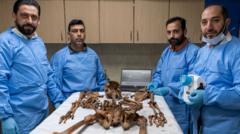
In Damascus, the newly established Syrian Identification Centre faces the formidable task of identifying remains from the countless mass graves created during the tumultuous years of civil war. Dr. Anas al-Hourani, the center's head, details the grueling start to this intricate process, with tables lined with femurs from what he describes as mixed mass graves—evidence that bodies were discarded in a chaotic manner. As of now, an estimated hundreds of thousands of Syrians have perished, victims of the Assad regime's brutal crackdown over 13 years.Dr. al-Hourani, a forensic odontologist, explains that while teeth can reveal vital information, currently the lab only has access to femurs, which can provide data on height, sex, and potentially signs of torture. Unfortunately, the situation is exacerbated by the existence of just one DNA testing laboratory within the country due to the destruction stemming from the civil war and various international sanctions impeding equipment availability.Funding is a significant roadblock, as the center depends solely on support from the International Committee of the Red Cross. In Syria, the ongoing transition from the Assad governance has led to governmental pledges for "transitional justice," but many families of the disappeared express frustration over the pace of progress in uncovering the fate of their loved ones.The scars of civil unrest are apparent, with over 130,000 reported cases of forced disappearances and extensive civilian casualties. Yet, identifying victims from mass graves is a painstaking process; preliminary estimates suggest that months may be required to name a single individual. “This will be the work of many, many years,” Dr. al-Hourani notes.A short distance from the center, eleven mixed mass graves lie at the outskirts of Damascus, now sunken into the earth after years of neglect. Eye-witness accounts, such as that of Abu Ali—a former military driver—shed light on the operations surrounding these mass graves. For over a decade, he transported hundreds of bodies from detention centers, affirming that many victims exhibited signs of severe abuse, suggesting they were primarily innocent civilians caught in the regime's crosshairs.This unsettling reality resonates with the stories of grieving families like that of Malak Aoude, who searches for her two missing sons, victims of enforced disappearance. Malak's harrowing journey reflects the persistent anguish among Syrians yearning for closure even after the fall of the Assad dynasty. The identification of remains remains crucial not only for justice but for the healing of a nation deeply scarred by conflict. Despite the recent changes, many households continue to face disturbing uncertainties, preserving the painful legacy of a long-battled war.