In brief
In a historic launch, a Japanese spacecraft departed Japan bound for Phobos, the larger of Mars' two moons, with the ambitious goal of collecting 10g of moon dust. The mission, part of the Mars Moons Exploration effort, will analyze the sample on Earth in 2031, potentially unraveling Moon formation theories. Scientists hope the tiny return will also contain Martian grains, offering direct clues about the Red Planet's surface. This endeavor marks the first time lunar material from Mars or its moons may be studied in, rather than on, our planet.
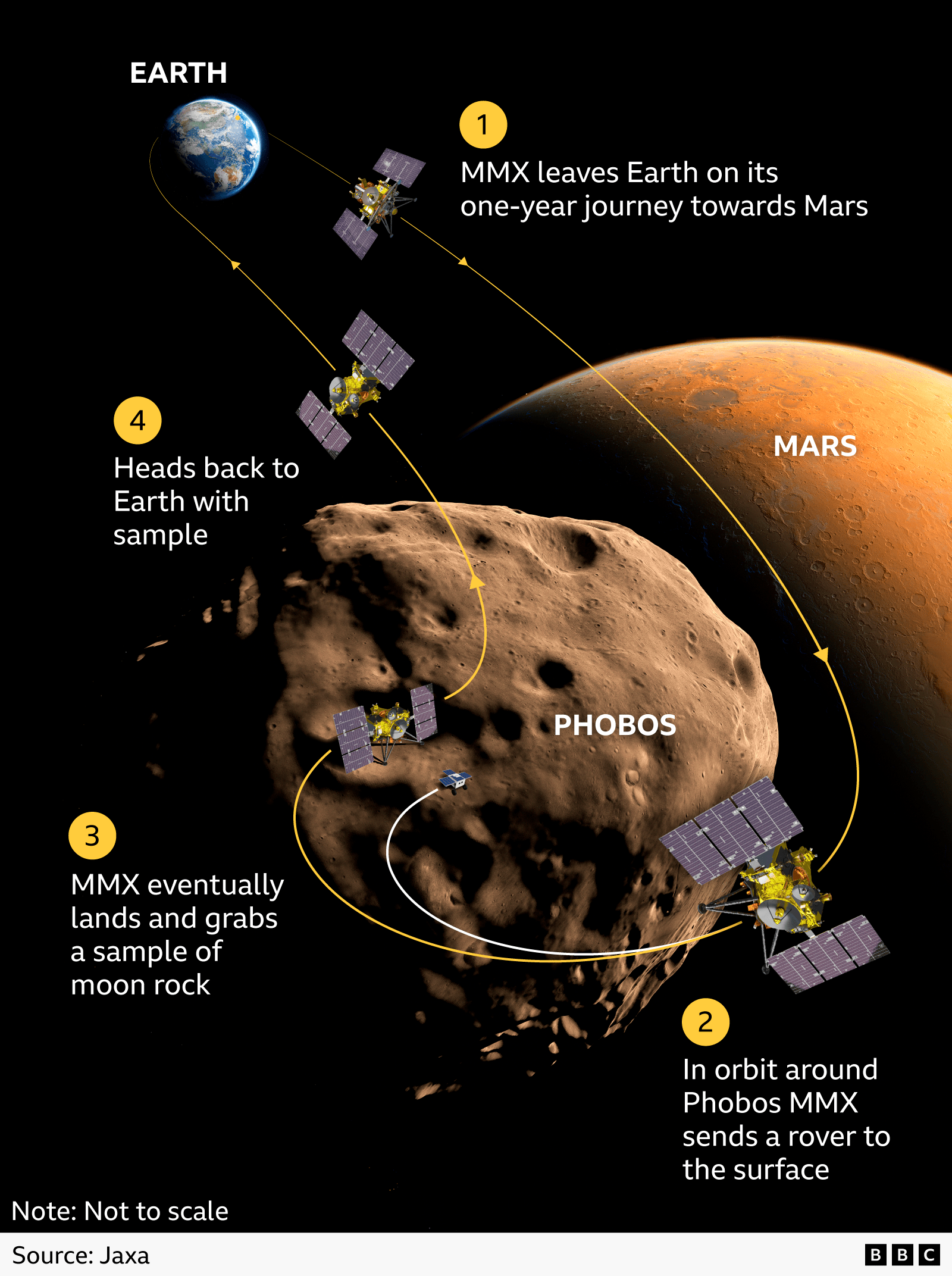
In a historic launch, a Japanese spacecraft departed from Japan heading for Mars' moon Phobos. The objective: to collect 10g of moon dust and return it to Earth in 2031, the first time that sample will be studied in a laboratory on Earth.
Scientists have long speculated about how Mars' tiny moons, Phobos and Deimos, came to be, but no mission has ever landed on them. The Mars Moons Exploration (MMX) mission, led by the Japanese space agency, hopes to solve that mystery by deploying a rover that will scout a touchdown site on Phobos before the probe itself lands.
The rover will extend a robotic arm and deploy two small samplers that will pocket dust and regolith. These tiny samples will be sealed in a capsule that will be lifted back to Earth by the probe’s return stage.
While 10g is almost nothing, scientists say the samples can still reveal rich chemistry. Dr Chrysa Avdellidou of Leicester University stresses that even individual grains can be analysed for minerals, offering extraordinary insights.
Phobos’ weak gravity complicates landing, but the probe will do so by using a system of small legs that will keep it anchored in low‑gravity conditions. The mission also plans to scan Deimos before redirecting to Phobos, giving scientists a broader view of both moons.
One intriguing possibility is that the dust returned may be a mix of Phobos material and grains from Mars itself. Impacts on the Martian surface could have sent dust onto Phobos, making the sample a direct link to Mars’ geological history.
The launch follows years of proven Martian science, with NASA’s Perseverance rover collecting samples and storing them for a future return mission that has encountered funding hurdles. China’s planned 2028 Mars sampling quest also targets a 2031 return, but it will focus on Martian rather than lunar material.
The return mission is a continuation of humanity’s quest for pristine extraterrestrial material. Unlike meteorites that arrive on Earth already mixed with Earthly contamination, samples from Phobos will be free from Earth's influence, providing an unaltered view of Martian space history.