
In brief
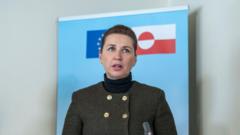
Prime Minister Mette Frederiksen leads Denmark's response to Donald Trump's threats regarding Greenland, advocating for the territory's autonomy, while political leaders express concern over potential US-China tensions and trade repercussions.
Denmark is confronting a diplomatic quandary following Donald Trump's bold assertion about potentially acquiring Greenland. In the shadow of a typically bleak January in Copenhagen, Foreign Minister Lars Løkke Rasmussen expressed the seriousness with which the government is taking Trump's comments, notably his threats to penalize Denmark with tariffs if it obstructs US interests. Yet, he emphasized a desire to avoid escalating the situation.Prime Minister Mette Frederiksen reacted to Trump's military suggestion with skepticism, stating, "I don't have the fantasy to imagine that it'll ever get to that." Despite the tranquility expressed in public, urgent high-level meetings were convened in Copenhagen, reflecting the dismay generated by Trump's claims. Greenland's leader Mute B Egede has consulted with Danish authorities this week, highlighting the political sensitivity around the issue.Frederiksen has sought to maintain diplomatic relations by labeling the US as “Denmark’s closest partner,” while asserting that the future of Greenland should be determined solely by its citizens. Her remarks come as Greenland navigates its indigenous identity, where calls for independence resonate amidst tension over colonial histories.Opposition voices suggest that Frederiksen's cautious stance could be interpreted as yielding to US pressure. They argue that a forthright dismissal of Trump's comments is essential to uphold Denmark's international stature and solidarity with Greenland.With Greenland's local governance structure and an economy heavily reliant on Danish support, questions of independence loom large. The potential implications of a split from Denmark could pose new economic challenges for Greenland, underscoring the delicate balance of autonomy and dependency that exists.Concurrently, the Danish trade sector holds its breath, with fears mounting over US tariffs that could significantly lower the GDP. A 2024 study projected potential economic fallout should Trump target Denmark with tariffs as a punitive measure.As President Trump's inauguration draws closer, international leaders, including Germany’s Chancellor Olaf Scholz and France’s Foreign Minister Jean-Noël Barrot, have asserted the importance of respecting sovereign borders, alluding to broader concerns about global treaty integrity under a Trump presidency.In the face of uncertainty, Danish officials are bracing for potential fallout while hoping that the Greenland issue may take a backseat as Trump’s focus potentially shifts to larger European allies. However, unpredictability remains, and the implications of Trump's handling of Greenland could redefine the scope of Denmark’s geopolitical landscape.



