In brief
Hektoria Glacier has experienced a dramatic retreat of over 8km in just two months, leading to speculation on whether this event could signal a new pattern in glacial behavior. The rapid changes have spurred discussions about the geological factors at play and the potential implications for global sea levels. While some researchers suggest the glacier's behavior is a groundbreaking phenomenon, others contend that the state of the glacier may not be as unique as claimed.
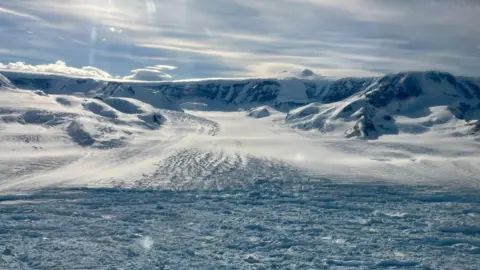
The recent rapid retreat of an Antarctic glacier could be unprecedented, a new study suggests, a finding which could have major implications for future sea-level rise. The researchers found that Hektoria Glacier retreated by more than 8km (5 miles) in just two months in late 2022. The authors believe it could be the first modern example of a process where the front of a glacier resting on the seabed rapidly destabilises. But other scientists argue that this part of the glacier was actually floating in the ocean – so while the changes are impressive, they are not so unusual.Floating tongues of glaciers extending into the sea – called ice shelves – are much more prone to breaking up than glacier fronts resting on the seabed. That's because they can be more easily eaten away by warm water underneath. That Hektoria has undergone huge change is not contested. Its front retreated by about 25km (16 miles) between January 2022 and March 2023, satellite data shows. But unraveling the causes is like a whodunnit mystery, according to study lead author Naomi Ochwat, research affiliate at the University of Colorado Boulder and post-doctoral researcher at the University of Innsbruck.The case began way back in 2002 with the extraordinary collapse of an ice shelf called Larsen B in the eastern Antarctic Peninsula. About 3250 sq km (1250 sq miles) of ice shelf was lost, roughly the size of Cambridgeshire or Gloucestershire. Larsen B had been effectively holding Hektoria Glacier back. Without it, Hektoria's movement sped up and the glacier thinned. But the bay vacated by the ice shelf was eventually filled with sea-ice fastened to the seabed, helping to partly stabilise Hektoria. That was until early 2022, when the sea-ice broke up.What followed was further loss of floating ice from the front of Hektoria, as large, flat-topped icebergs broke off or calved, and the ice behind sped up and thinned. That is not unusual. Iceberg calving is a natural part of ice sheet behavior, even though human-caused climate change makes the loss of ice shelves much more likely. What was unprecedented, the authors argue, was what happened in late 2022, when they suggest the front of the glacier was grounded - resting on the seabed - rather than floating. In just two months, Hektoria retreated by 8.2km. That would be nearly ten times faster than any grounded glacier recorded before, according to the study, published in Nature Geoscience. This extraordinary change, the authors say, could be thanks to an ice plain - a relatively flat area of bedrock on which the glacier lightly rests. Upward forces from the ocean water could lift the thinning ice essentially all at once, they argue - causing icebergs to break off and the glacier to retreat in quick time. Glaciers don't usually retreat this fast, said co-author Adrian Luckman, professor of geography at Swansea University.The circumstances may be a little particular, but this rapid retreat shows us what may happen elsewhere in Antarctica where glaciers are lightly grounded, and sea-ice loses its grip. What makes this idea even more tantalising is that this process has never been observed in the modern world, the authors say. But markings on the seafloor suggest it may have triggered rapid ice loss into the ocean in the Earth's past. What we see at Hektoria is a small glacier, but if something like that were to happen in other areas of Antarctica, it could play a much larger role in the rate of sea-level rise, said Dr. Ochwat. That could include Thwaites – the so-called doomsday glacier because it holds enough ice to raise global sea-levels by 65cm (26in) if it melted entirely. It's really important to understand whether or not there are other ice plain areas that would be susceptible to this kind of retreat and calving, Dr. Ochwat added.However, other researchers have contested the study's findings, emphasizing uncertainties surrounding the glacier’s grounding line – the crucial point where the glacier transitions from grounded to floating. As scientists continue to examine the landscape of Hektoria Glacier, it becomes evident that while the mechanisms driving its retreat are still under investigation, the results underscore the changing dynamics of polar regions in the context of global warming.