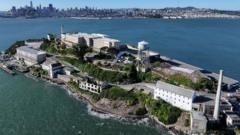
President Donald Trump is once again advocating for the reopening of the infamous Alcatraz prison, a facility that has been closed for over six decades but remains a historical landmark. Known as "the Rock," Alcatraz is located about 1.25 miles off the coast of San Francisco and has seen millions of tourists flock to it annually. Trump believes that Alcatraz could serve as a solution for housing violent offenders, reinforcing his administration's narrative on law and order. Nonetheless, experts completely reject the idea as unrealistic.
Originally constructed as a fort and later transformed into a military and subsequently a federal prison in 1934, Alcatraz famously housed notorious criminals, including mobster Al Capone. Its reputation as an inescapable fortress was solidified by the treacherous waters surrounding it. The prison not only features in historical accounts but also inspired films, including Clint Eastwood's "Escape from Alcatraz" and "The Rock," which further etched its place within popular culture.
Alcatraz's closure in 1963 came after it was deemed too costly to operate, costing nearly three times more than other federal prisons. Today, it operates as a museum managed by the National Park Service, attracting over 1.4 million visitors annually. Christine Lehnertz, head of the Golden Gate National Parks Conservancy, emphasizes the site's importance in linking history with contemporary society.
Trump's recent proposal echoes past considerations of reopening Alcatraz, such as in 1981 when it was considered as a refuge site for Cuban migrants. However, any plans were scrapped due to the area's unsuitable facilities.
In his May 4 post on Truth Social, Trump indicated he had instructed his government to explore revitalizing Alcatraz, claiming that America is facing serious crime challenges. Speaking to reporters, Trump acknowledged both Alcatraz's changeable condition—a "big hulk" he described as "rusting and rotting"—and its symbolic weight.
Despite the enthusiasm from the Trump administration, including comments from border czar Tom Homan who acknowledged Alcatraz as a possible site for radical offenders, numerous experts have voiced skepticism. Former BOP Director Hugh Hurwitz remarked that the repairs needed to restore Alcatraz are nearly insurmountable. With buildings deteriorating, outdated security measures, and critical infrastructure lacking, Hurwitz asserted that true repair might not only be difficult but impossible.
Alcatraz historian Jolene Babyak echoed this sentiment, highlighting that modern standards for sanitation and sewage management are inadequate by current standards. Furthermore, costly logistics—including food and supplies transported by boat—are compounded by the facility's decreased capacity to house around 340 inmates.
Historical expert John Martini, who worked at Alcatraz, declared the site a shell in dire need of modern updates to function as a prison today. Ultimately, while Trump's vision has captured the public's attention, the vast financial and logistical hurdles make turning the notion of reopening Alcatraz into reality seem increasingly tenuous.