In brief
In a significant diplomatic development, the UN is preparing to reinstate sweeping sanctions on Iran as a response to the country’s alleged non-compliance with nuclear commitments. Following a letter from the UK, France, and Germany to the UN Security Council, Iranian President Masoud Pezeshkian condemned the sanctions as 'unfair' and 'illegal.' With potential military and economic ramifications, the sanctions include an arms embargo and restrictions on uranium enrichment. Diplomatic efforts to avert these measures may still pivot on ongoing negotiations regarding Iran's nuclear program.
The United Nations' sweeping economic and military sanctions look set to be reimposed on Iran a decade after they were lifted in a landmark international deal over its nuclear programme.
It comes after the UK, France and Germany wrote to the UN Security Council last month, accusing Iran of failing to fulfil its commitments. That triggered a mechanism giving Iran 30 days to find a diplomatic solution to avert renewed sanctions.
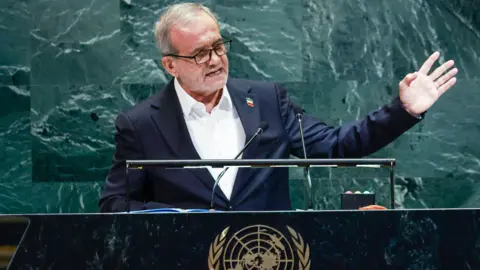
Iran's President Masoud Pezeshkian condemned the re-imposition of international sanctions as unfair, unjust, and illegal.
A last-minute resolution, led by China and Russia, to delay the move by six months only received four votes in the 15-member council.
The sanctions are set to come into force at 00:00 GMT on Sunday.
Iran stepped up banned nuclear activity after the US quit the deal in 2016. Donald Trump pulled the US out in his first term as US president, criticising the deal - the Joint Comprehensive Plan of Action (JCPOA) - negotiated under his predecessor Barack Obama as flawed.
Iran barred IAEA inspectors from accessing its nuclear facilities after Israel and the US bombed several of its nuclear sites, as well as military bases, in June after negotiations held indirectly between the US and Iran to try to reach a new nuclear deal became deadlocked.
President Pezeshkian told the UN this week that his country would never seek to build a nuclear bomb.
Speaking to a group of journalists, Pezeshkian accused foreign powers of seeking a superficial pretext to set the region ablaze, insisting that, despite previous threats, Iran would not quit the Non-Proliferation Treaty.
But he added that Tehran would need reassurances that its nuclear facilities would not be attacked by Israel in order to normalise its nuclear enrichment programme.
Pezeshkian kept pointing to the negotiations that had taken place before Israel and the US bombed Iran's nuclear sites in June and accused the Americans of not taking the talks seriously. The sanctions add yet more strain to an already fraught situation.
The sanctions would include:
- an arms embargo
- a ban on uranium enrichment
- a ban on activity connected to ballistic missiles capable of delivering nuclear weapons
- a freeze of assets and a travel ban on Iranian figures and entities
- authorisation of countries to inspect Iran Air and Iran Shipping Lines cargo
Unless a solution is found, UN sanctions would come into force first, followed by EU sanctions next week.
European foreign ministers had tried to avert the council's step by urging Iran to resume negotiations with the US; to cooperate with the UN's nuclear watchdog the IAEA, and to account for its highly enriched uranium stockpile.
Speaking at the UN on Friday, Iranian Foreign Minister Abbas Aragchi said: The United States has betrayed diplomacy, but it is the E3 (Britain, Germany, and France) which have buried it.
The negotiation with the United States is in fact a pure dead end, Aragchi added.
Iran is legally obliged under the nuclear treaty to allow inspections.
It has been in talks this week with the IAEA to find a way forward, but has warned that a return of sanctions will put that in jeopardy.
On Friday, the IAEA confirmed that inspections of Iranian nuclear sites had resumed this week after a hiatus following Washington and Israel's strikes.
Western powers and the IAEA say they are not convinced that Iran's nuclear programme has purely peaceful purposes.
Iran strongly insists it is not seeking nuclear weapons and that its programme is solely a civilian one.
Russia on Friday signed a $25 billion deal with Iran to build four nuclear power reactors in southern Iran, Iranian state-run IRNA news agency reported.