
In brief
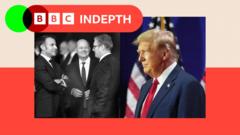
Europe is facing a complex re-evaluation of its relationship with Donald Trump, whose transactional approach to politics raises concerns in a continent beset by economic difficulties and political fragmentation. Leaders are exploring various strategies to navigate a potentially turbulent future.
With Donald Trump’s election to the White House, European leaders are bracing for a complex recalibration of transatlantic relations. Voters from northeast Germany express frustration over domestic issues being overshadowed by Trump's re-emergence, suggesting that many share a similar sentiment in the face of impending snap elections across Europe. Despite grappling with their own tensions in major economies like France and Germany, Europe has remained fixated on the impacts of Trump 2.0. This focus raises questions about the continent's readiness to handle a president who once again emphasizes America’s transactional stance over historical alliances. Angela Merkel's reflections during Trump’s previous presidency highlight a consensus among European leaders that Trump views partnerships through a lens of winners and losers.As Trump threatens punitive tariffs on the EU and openly questions commitments to NATO, concerns rise within Europe regarding the stability of transatlantic defense and trade policies. With Trump’s statement claiming he would “encourage” Russian maneuvers if European nations didn’t increase their defense spending has raised alarms. The implications of such declarations are profound, particularly with Germany’s economy showing signs of slowing, emphasizing a pivotal trade imbalance that has drawn Trump’s ire historically.Trade discussions come with additional layers of complexity. Trump’s potential blanket tariffs pose a serious risk to Germany's key export-driven economy, particularly in the automobile sector, which is already fragile after a contraction last year. This precarious situation underscores how intertwined Europe’s fortunes are with Trump’s policies.The unpredictability of Trump's leadership raises uncertainties among analysts, pointing out that Europe may not be fully prepared for the tumultuous trade relations that could unfold. Observers note that Trump's strategies could provoke retaliatory measures and supply chain disruptions related to China, thus complicating the existing dynamics further.When it comes to defense spending, there’s a semblance of consensus among European nations regarding the need to bolster military budgets. However, the debate centers around whether to increase expenditure in nominal terms or to strategize around efficient spending practices to enhance joint military capabilities on the continent.French President Emmanuel Macron's initiatives to foster a more unified European defense policy emphasize the recognition of internal fragmentation as a weakness. As Europe's political landscape shifts with right-leaning governments potentially gaining influence, the approach to dealing with Trump looks set to vary across the continent. Ultimately, as leaders maneuver to oppose Trump’s demands while courting his favor, a critical question remains: will Europe be able to strike a balance between asserting its interests while accommodating an unpredictable leader? The evolving dynamics suggest that a new narrative will soon unfold in how Europe positions itself vis-à-vis an assertive transatlantic partner.

