
In brief
The ongoing conflict between nuclear-armed India and Pakistan has entered a perilous new phase with the exploitation of drone technology. Accusations of drone and missile attacks, grounded in mutual denials, highlight a risky escalation in military capabilities, prompting concerns from global powers about potential broader conflicts.
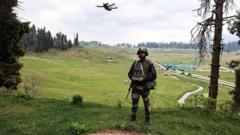
The conflict between India and Pakistan has recently escalated into what many are calling the world's first drone war. On Thursday, Indian officials accused Pakistan of launching numerous drones and missiles against military bases located in Indian-administered Kashmir. In response, Pakistan claimed to have shot down at least 25 Indian drones in multiple cities, including Karachi and Lahore. These exchanges indicate a significant evolution in the decades-old rivalry as both nations employ unmanned aerial vehicles (UAVs) alongside traditional artillery.Experts are sounding alarms about the increasing role of drones in this conflict, suggesting that the developments could lead to dangerous escalations. The ongoing confrontation has seen reports of civilian casualties, with Pakistan claiming that Indian air strikes and cross-border shelling have led to at least 36 deaths on their side, while India reported 16 civilian casualties due to Pakistani shelling. These violent exchanges are further complicated by the underlying tensions, as India cites a deadly militant attack on Indian tourists as justification for its missile strikes.With its drone capabilities primarily centered around Israeli reconnaissance UAVs and loitering munitions, India is enhancing its military strategy to include more precise drone warfare tactics. The recent $4 billion deal between India and the U.S. for MQ-9B Predator drones signifies a strategic advancement in this area. On the other hand, Pakistan's drone fleet, described as extensive, comprises a variety of systems, including those developed in-house and imported from allies like China and Turkey, emphasizing the ongoing arms race between these two nations.While both countries are leveraging drone technology, the differences in their approaches are evident. Indo-Pakistani drone warfare, as experts note, is not comparable to the extensive use of UAVs observed in the Russia-Ukraine conflict. The ongoing exchanges of drone strikes and counterattacks seem to reflect tactical responses rather than a full-scale military engagement.As political analysts weigh the implications, they point out that the introduction of drones lowers the threshold for military engagement but also raises the stakes for potential escalation. Incidents involving drones, like downed UAVs or targeted strikes, could easily ignite further conflict between these two nuclear powers.In conclusion, the intersection of drones with the long-standing India-Pakistan conflict represents a crucial moment in military engagements and international relations, with the potential for either de-escalation or a more significant escalation looming on the horizon. The involvement of global powers urging restraint underlines the significance of these developments on the world stage. The future direction of this conflict remains uncertain as both countries navigate a treacherous new landscape of warfare.
