In brief
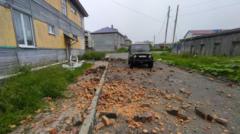
The recent 8.8-magnitude earthquake in Russia's Kamchatka Peninsula, one of the strongest on record, caused concerns for potential tsunamis. However, the resulting tsunami was significantly less damaging than feared. Key factors influencing this included the earthquake's depth, the region's geography, and improved early warning systems that allowed for timely evacuations.
The Kamchatka Peninsula in eastern Russia faced fears of massive tsunami damage after a powerful 8.8-magnitude earthquake struck at 11:25 local time on Wednesday (00:25 BST). This stunning geological event raised alarms reminiscent of past catastrophic tsunamis in 2004 and 2011, prompting evacuations for millions along the Pacific coast. Despite its intensity, the earthquake led to a much less devastating tsunami than many had expected.The earthquake's origin is traced to the "Pacific Ring of Fire," where tectonic plates, including the Pacific plate, move towards the Okhotsk microplate. The friction created by this movement can release considerable energy suddenly, resulting in a megathrust earthquake. Dr. Stephen Hicks from University College London elaborated that such earthquakes, characterized by extensive fault ruptures, can generate high magnitudes.Tsunamis form when such seismic activity displaces significant amounts of water. Typically, in deep ocean waters, tsunami waves can travel at speeds over 500 mph (800 km/h) with long intervals between them. However, as they approach the shallower coastal areas, waves slow down and grow larger—sometimes forming towering walls of water. While the recent quake resulted in tsunami waves reaching 4 meters (13 feet), these figures pale in comparison to the catastrophic waves recorded in past disasters.Several factors contributed to the minimized impact of the tsunami. The unique seafloor topography near the coast influences wave height, and initial depth reports indicated a relatively shallow epicenter—about 20.7 km (12.9 miles) deep. Dr. Hicks noted that if future assessments deepen the quake by about 20 km, the tsunami's amplitude could diminish considerably.Additionally, advanced early warning systems played a critical role in mitigating the potential disaster. Countries around the Pacific have established tsunami centers that notify populations to evacuate ahead of time—contrasting sharply with the lack of such systems during the Boxing Day tsunami. Enhanced monitoring of seismic activities helps scientists assess risks and issue valuable forecasts, although precise predictions remain elusive.As the Geophysical Survey of the Russian Academy of Sciences continues to monitor the area, authorities remain vigilant for aftershocks over the coming month, emphasizing the ongoing geological volatility in this quake-prone region.