
In brief
Asian markets face a significant decline with fears of recession looming, influenced by President Trump's new tariffs affecting key economies.
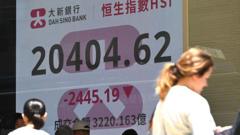
Asian stock markets experienced their worst declines in decades on Monday as a result of escalating fears surrounding U.S. President Donald Trump's implementation of new tariffs. The fallout was evident, with the Shanghai Composite index plunging over 8%, Hong Kong's Hang Seng sinking more than 13%, and Japan's Nikkei 225 closing down by 7.8%. Analysts described the situation as a "bloodbath" for investors anticipating a trade war that could lead to economic slowdowns or recession in the U.S., the world's largest economy. The impact of Trump's tariff announcements, which range between 10% and 46%, is particularly damaging for Asia's manufacturing hubs heavily reliant on the U.S. market. Developed nations like Japan and South Korea, faced with 26% tariffs, along with developing nations such as Vietnam with a staggering 46% levy, are bracing for the consequences. Countries like Cambodia, Thailand, and China are set to experience even harsher tariffs, further destabilizing their economies. Qian Wang, chief economist at Vanguard for the Asia Pacific region, emphasized, "Asia is bearing the brunt of the U.S. tariff hike," and warned that a new regime of elevated tariffs appears to be a persistent reality. Concerns over a global trade war have heightened anxieties that it could lead to a severe economic downturn in the U.S., thereby adversely affecting Asian exports. Following public holidays, markets in mainland China, Hong Kong, and Taiwan have seen significant slumps, with the Shanghai Composite closing 7.3% lower and Taiwan's Weighted Index losing 9.7%, marking its largest fall to date. Australia’s ASX 200 and South Korea's Kospi also dropped by 4.2% and 5.6% respectively. The Hang Seng's closing drop at 13.22% represented its most significant decline since 2008. Amidst rising inflation expectations and recession warnings, Goldman Sachs has now estimated a 45% likelihood of a U.S. recession occurring in the next year, a notable increase from its previous forecast of 35%. Other firms like JPMorgan have projected a 60% chance of a downturn in both the U.S. and global economies. This is particularly concerning for smaller nations like Vietnam and Bangladesh, which are increasingly reliant on U.S. exports. The repercussions from Trump's tariffs are projected to continue wreaking havoc, as major retailers like Nike and Gap are known to produce goods in Vietnam, and Bangladesh generates approximately $8.4 billion from garment exports to the U.S. Consequently, tariffs hitting these countries are detrimental to their economic stability. China, as the largest economy in Asia, has also retaliated with its tariffs, contributing to the ongoing global market turmoil. In the U.S., key stock indexes fell by over 5%, culminating in the worst week for the stock market since 2020, with the S&P 500 plunging almost 6%. Other markets, including the FTSE 100 in the U.K. and European exchanges, faced historically steep declines. Market analysts predict continued volatility, suggesting that additional downturns may lie ahead as traders react to the fallout from the tariffs.

