
In brief
Russian President Vladimir Putin has rejected Western proposals for a reassurance force in Ukraine, warning that any foreign troops deployed would be considered legitimate targets. This comment follows a Paris summit where leaders, including French President Emmanuel Macron, discussed security guarantees amidst ongoing conflict in Ukraine. Despite acknowledging a potential for peace, Putin’s remarks dismissive of foreign involvement indicate a bleak outlook for negotiations.
Russian President Vladimir Putin has rejected Western proposals for a 'reassurance force' in Ukraine the day after any ceasefire comes into place, following a Paris summit aimed at finalising plans for security guarantees.
French President Emmanuel Macron said 26 of Ukraine's allies had formally committed to deploying troops 'by land, sea or air' to help provide security the moment fighting was brought to a halt. He did not detail any of the countries involved.
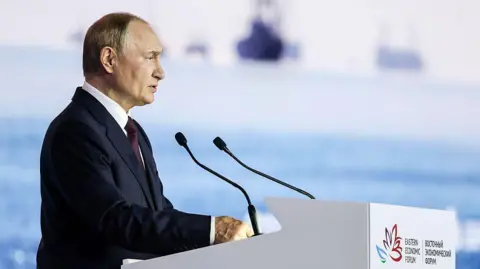
Putin sought to quash the allies' initiative, with a warning that any troops deployed to Ukraine would be 'legitimate targets', especially if they appeared now, even though there are no plans for an immediate deployment.
There seems little hope of a ceasefire for now, after last month's summit in Alaska between Putin and US President Donald Trump briefly raised hopes of a meeting with Ukraine's Volodymyr Zelensky and a potential peace deal.
Putin said on Friday he was ready for contact with the Ukrainian leader 'but I do not see much point. Why? Because it is nearly impossible to reach agreement with the Ukrainian side on key issues'. His spokesman, Dmitry Peskov, praised Trump's 'very constructive efforts' in finding a solution, but attacked 'the outrageous efforts of European countries to provoke continuation of the war'.
Since the Alaska meeting, the 'Coalition of the Willing' - led by the UK and France - has been working intensively on providing Kyiv with guarantees if an agreement is reached. These would involve strengthening Ukraine's military as well as providing a 'reassurance force' to patrol any deal.
Macron stressed any troops would be deployed to prevent 'any new major aggression' and not at the front line. The force 'does not have the will or the objective of waging war against Russia', he said.
Zelensky described the decisions taken at Thursday's Paris meeting as the first concrete step.
While the US has not made the scale of its involvement clear, Trump indicated that American backing could 'probably' come in the form of air support, and Zelensky said he had spoken to Trump about 'maximum protection for Ukraine's skies'.
Putin argued that if decisions are reached that lead to long-term peace, then he does not see the point in foreign troops' presence in Ukraine and claimed Russia would comply with any peace decisions 'in full'. However, Kyiv and its Western allies find his statements unconvincing.
Putin also mentioned he is ready to host a summit with Ukraine in Moscow, offering to provide security, but this proposal has been met with skepticism. Zelensky has ridiculed Moscow's idea as proof that Putin is not serious.
Putin's remarks highlight the ongoing tensions and challenges in reaching a ceasefire amidst escalating conflict, with the potential for significant geopolitical implications.
