
In brief
In his inaugural speech, Donald Trump claimed China "operates" the Panama Canal, a statement met with strong denials from Panamanian officials. The Panama Canal is managed by the Panama Canal Authority, and while China is a significant user and has invested in regional ports, there is no evidence that it controls the canal itself. Trump's remarks reflect growing U.S. concerns over China's expanding presence in Latin America.
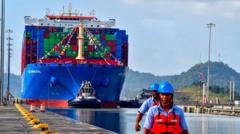
Former President Donald Trump's recent assertion that "China is operating the Panama Canal" has ignited considerable debate, particularly among Panamanian authorities who have emphatically rejected such claims. During his inaugural address, Trump reiterated his perspective, emphasizing that the canal was given to Panama and suggesting that control should be returned to the United States—a notion that ignores historical realities. The Panama Canal, which is approximately 51 miles long and acts as a vital link between the Atlantic and Pacific Oceans, plays a crucial role in global trade, accommodating up to 14,000 ships annually and representing about 5% of worldwide maritime trade. Trump's comments are not isolated. In previous social media posts, he described Chinese military personnel as "lovingly, but illegally, operating" the canal. This unfounded claim was promptly countered by both Panamanian President José Raúl Mulino, who denounced it as "nonsense," and by Chinese officials.Since the Panama Canal Authority gained exclusive rights to operate the canal in 1999 under treaties signed with the U.S., there has been no evidence that any foreign military or government, including China, has any operational control. Nonetheless, Trump's statements reflect underlying U.S. concerns regarding China's significant investments near the canal and overall influence in Latin America—a region historically seen as within the U.S. sphere of influence.China currently ranks as the second largest user of the canal, with 21.4% of total cargo passing through from October 2023 to September 2024. Chinese investment in the area includes operational stakes in two major ports, Balboa and Cristóbal, under a subsidiary of Hutchison Port Holdings since 1997, leading to fears in Washington about potential strategic advantages China might gain.This geopolitical competition has heightened alongside China's proactive moves in the region, including establishing formal relations with Panama after the latter broke ties with Taiwan in 2017. China's Belt and Road Initiative has also led to increased investments in infrastructure in Panama, a shift that has caused unease among U.S. officials.Despite threats from Trump to "take back" control of the canal, Panamanian leaders maintain firm control over its operations. The country's sovereignty over the strategic waterway remains intact, with the government assuring that no foreign nation interferes with its administration.

